Wednesday, July 17, 2013

Great Style at NYC Sustainable and Ethical Fashion Show

Models for 8 designers from New York City's Fair Trade Coalition strutted their stuff last week at a fashion show held at NYC's Fashion Institute of Technology.

The show was part of a 3 day sustainable fashion conference which had hands on workshops, like fabric dying using organic dyes, to breakout sessions, such as that on creating your digital media presence by sustainable fashion guru Kate Black, Founder of Magnifeco.


Expert panels rounded out the event, such as this one shown below, with Public Relations Specialist Jane Tabachnick, who moderated Jasmin Chua, Managing Editor of Ecouterre, Kristen Arnett, Founder and Editor-In-Chief of Green Beauty Team, and Fashion Compliance and International Trade attorney Deanna Clark, Esq. on the usage and evolution of "Green" and other environmental marketing claims.


All clothing and accessories worn by the models are made using fair trade principles and are made by designers who are part of the ethical fashion community in NYC.  

Designers include, Bhoomki, McColl & Clan, Simply Natural, Tabii Just, Elsa and Me, Tara Lynn Bridal, Reborn by Soham Dave, and Kibonen, who delivers both sustainable and ethical fashion from her production process in Cameroon to her shop in Harlem.  You can find her great designs at Kibonen's NYC store at 116th St. and Lenox Ave.

Questions/comments?  Post below or email me at fashioncompliance@gmail.com

Connect with me on Twitter @fashcompliance and join me at Fashion Compliance on Facebook!


Sunday, July 14, 2013

Luxury Africa – The Aesthetic Means More Than Just Great Fashion


Africa Fashion Week 2013 Celebrates Sustainable Luxury

Accessing these beautiful designs and increasing international trade with African countries is only a part of the reason why Africa Fashion Week 2013, starting this week from July 15 – 20th, 2013, is so important.


Purchasing products that impact families, establishes communities and raises awareness on social issues across the continent are just a few of the benefits that come from buying apparel Made in Africa.


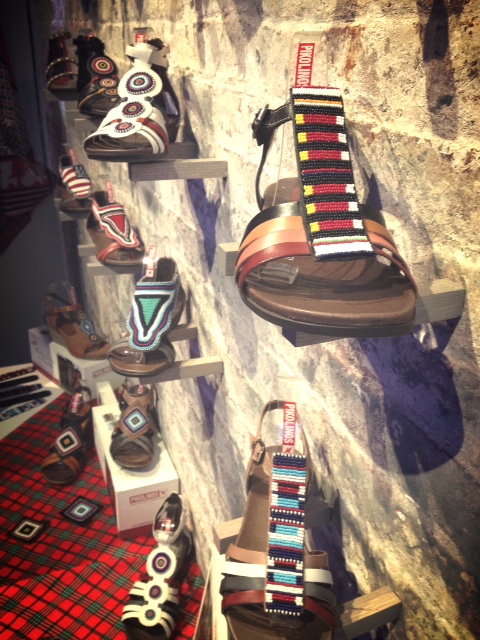
Spain-based footwear and apparel label “Pikolinos” turned to the Maasai people in Kenya to embellish its sandals with gorgeous beadwork. 

Recently, I attended an Africa Fashion Week pop-up shop at Pikolinos in NYC’s hip Meatpacking District. 
In addition to designers being in attendance, such as Missal Mussa (below right) from Zanzibar who is wearing a “Kikoe" type of skirt, there was also a sampling of the fashion to come from this year’s runway shows, such as this shirt above by designer Reuben Reuel De-Mestiks.


I enjoyed all the great design and of course, seeing my pals, including the Founder of Africa Fashion Week, Ms. Adiat Disu (shown with me in left photo above).

In a video entitled, Our Take with Christina Brown & African Fashion Chic," Global Ambassador to Pikolinos, Ms. Bisila Bokoko, explains that the Maasai are a recognized tribe in today’s modern world and this collaboration has enabled Maasai parents to send their children to school, improve relations between husband and wife, and have access to better medical attention, among other reasons.

Mikaila Kim, fashion designer of “Aliakm” shown in the Arise News video, not only designs beautiful garments but she also incorporates images of child soldiers, brass knuckles and guns into her apparel in order to raise awareness about terrible events and realities that should not be forgotten.

Check out www.afwny.com for all the latest on African fashion and watch the Arise TV video to learn more.

Questions/comments?  Post below or email me at fashioncompliance@gmail.com

Keep up with me on Twitter @fashcompliance

Join us on Facebook on the Fashion Compliance page https://www.facebook.com/FashionCompliance

Friday, July 5, 2013

INDIA, DESIGN AND COTTON

India is known for its beautiful monuments and palaces, many of which were built over several hundreds of years ago.


It is likewise known for its designs and the patterns and shapes that have inspired countless artists, home fashions and furniture designers.

 India grows a lot of cotton and many of the t-shirts and other apparel manufactured there and in neighboring countries like Bangladesh originate from Indian cotton.


Here in the US we wear a lot of cotton garments manufactured in both of these countries, and if I had to guess, most of the time this little fact is overlooked.  

Have you ever stopped to ask yourself where the cotton you are wearing  comes from and how it got from the field to the factory?

Here are some images of a modern day mode of transportation in India where the farmer takes its raw goods from the field to the weigh stations to get paid for his crop.


One of the most fascinating aspects about international trade to me is the marriage of modern technologies contrasted with tried and true methods, all working in harmony together.  

One such example is that of the sophisticated container ship used for ocean transport of the finished goods that were once carried, in raw form, via camel power.  Pretty cool stuff.

Questions/comments?  Post below or email me at clark.deanna@gmail.com

Follow me on Twitter @fashcompliance

Keep up with me on Facebook by "liking" our Fashion Compliance page at https://www.facebook.com/FashionCompliance?ref=hl


Monday, July 1, 2013

Sustainable Fashion Beauty & Health Symposium @ FIT NYC

 Come Join Me for the Fashion Institute of Technology's
2nd Annual Sustainable Fashion Symposium! 

On July 11th, I'll be speaking on "Green Marketing Claims" during the afternoon panel starting at 3 PM.  Other highlights include a sustainable fashion tour in NYC, a sustainable fashion show, and networking events.  For tickets to the event, click here.


For current F.I.T. students with valid I.D., COMPLIMENTARY ADMISSION is available by typing in the promotional code "STUDENT" at checkout.  In order to gain access to the conference you will be required to show your F.I.T. student i.d. card, so don't forget it!
 
Questions/comments?  Post below or email me at fashioncompliance@gmail.com

Follow me on Twitter @fashcompliance or "like" us on the Fashion Compliance Facebook page
https://www.facebook.com/FashionCompliance
 

Friday, June 21, 2013

Looking to Buy Products Made in the USA?

The Office of Textiles and Apparel at the US International Trade Administration has a handy portal to help sellers find vendors who manufacture products made in the USA.


Specific to the textiles and apparel industries, the portal allows you to search for vendors of children’s wear (including infants), men’s and boy’s, or women’s and girl’s apparel, in addition to accessories and footwear, technical textiles as well as soft furnishings.

You can further search by fabrics, whether of wool, cotton, upholstery, silk and other fabrics.

Whether searching for a cut and sew contractor, input supplier, manufacturer or other type of business, the information you will get back includes an entity’s contact information, whether or not they export, production capacity and production locations.

You can also learn if they have design capabilities, have any special washes or treatments available, certifications offered and many other details.
To go to the Made in USA search portal, click here.

Questions/comments?  Post below or email me at fashioncompliance@gmail.com

Monday, June 10, 2013

How to Mark a Commercial Sample as a “SAMPLE”

Say you want to set up a carpet business and need carpet samples to show prospective buyers your range of colors.


Commercial samples become an issue for US Customs primarily under two (2) scenarios. 

The first is where an importer, because it is importing a product it does not intend to resell, seeks to avoid marking a product via use of one of the country of origin marking exceptions.

The second is where an importer seeks duty-free treatment of the merchandise being imported by classifying it as a commercial sample under a special provision in chapter 98 of the Harmonized Tariff Schedule of the US (HTSUS).

Chapter 98 of the HTSUS has a special provision regarding the duty-free entry of a commercial sample under HTSUS heading 9811.00.20 when use of the sample is for the purpose of soliciting purchase orders for foreign merchandise and the creation of demand for future orders.  Such treatment is afforded when the sample is

1.    Not valued over $1, OR

2.    Is marked, torn, perforated or otherwise treaded so that it is unsuitable for sale or for use otherwise than a sample.
Whereas not having the ”SAMPLE” marking may raise an issue by a US Customs border inspector, marking it “SAMPLE NOT FOR RESALE” eliminates any issue.  A best practice is to instruct your foreign vendor to mark the sample so as to minimize any ambiguities.

One way to mark these little guys would be as shown in the image below.


Again, such recommendation is being made in order to avoid issues that could arise due to an inspection of the sample. 
 
Questions/comments?  Post below or email me at clark.deanna@gmail.com
 
Keep up with me on Twitter @fashcompliance.


Saturday, June 1, 2013

Obtaining Export Declarations Under the AGOA Agreement

The US has preferential trade agreements with many other countries to promote and increase trade with those nations.

One of these is the “African Growth and Opportunity Act,” otherwise known as the AGOA agreement.

Doreen Mashika Print Clutch Bags - Zanzibar


As it pertains to textiles, its purpose is (in part) to provide for the entry of specific textile and apparel articles free of duty and free of any quantitative limits from the participating countries of sub-Saharan Africa.

For more information about the AGOA, check out these articles:


AGOA Renewal Recommendations Sought by USTR

 For preferential treatment under AGOA, the exporter is required to prepare a certificate of origin and provide it to the importer.  This certificate is something that the importer must request from the exporter to have and keep as part of its record keeping.  The certificate of origin includes information such as

(1)    The contact information for the importer, exporter and producer;

(2)    The basis for which preferential treatment is claimed; and

(3)    A description of the imported merchandise.

Importers are required to have the certificate in their possession at the time of the claim, and to provide it to Customs and Border Protection (CBP) upon request.

Questions/comments?  Post below or email me at clark.deanna@gmail.com
Keep up with me!

On Facebook at https://www.facebook.com/FashionCompliance 

On YouTube at http://www.youtube.com/user/fashioncompliance 

On Tumblr: http://fashioncompliance.tumblr.com

On Twitter @fashcompliance https://twitter.com/fashcompliance