Showing posts with label african growth and opportunity act. Show all posts

Wednesday, June 24, 2015

AGOA Matters!


Today I joined a conference call with White House Senior Administration officials to talk about the President’s trade agenda in relation to the African Growth and opportunity Act (AGOA).


Notably, the renewed AGOA agreement is different from prior AGOA renewals in at least 3 ways.

The first is that the length of the extension of the AGOA agreement will be for 10 years.

The second is that “Third Country Fabric Provision” will be extended the same length as the renewed AGOA, so we no longer have to worry about this provision expiring before the AGOA extension itself.

The third is that a value on African labor, as opposed to just materials themselves, will now be considered.

The Brookings Institution put out a great analysis on the state of the AGOA, which can be viewed here.

Questions/comments? Post below or email me at clark.deanna@gmail.com

Keep up with me at www.fashioncompliance.com or:
On Twitter @fashcompliance

Monday, March 9, 2015

Harmful Shifts in the US Economy Without a New Beginning for AGOA?

Still think the economy is sluggish?  


(photo courtesy of U.S. CIA)

The gridlock in Congress isn’t helping and with their delays in reauthorizing trade agreements like the African Growth and Opportunity Act (AGOA), U.S. companies whose existence rely upon duty-free African imports – whether in fashion, retail, beauty, foodstuffs, or otherwise - are going to start laying off people as the uncertainty with respect to AGOA renewal mounts.

Here’s a snapshot of reasons, recommendations, and how you can support AGOA renewal in 2015.

AGOA renewal is important not only for keeping existing companies in business but also for the expansion of other US companies who find markets within African economies.

A rise in African exports equals increased spending power amongst African consumers, and with President Obama’s export promotion initiative in place, this means that US exports have a greater chance for success when expanding into these foreign markets. 

A growing African labor force could also lead to more stable economies and increase good governance.  With greater economic development and stability, there will be less of an incentive to join radical groups known to be destructive and that pose a threat to the world at large, as there will instead be a viable alternative to have a life with meaning and, hence, a vested interest in creating a common good for society as a whole.

Now is the time to make your voice heard if you want Congress to vote for the reauthorization of the AGOA trade agreement.  Send letters to all of the members of the House Ways and Means Committee and the Senate Finance Committee, calling for:

1) The expeditious passage of AGOA
2) Renewal for a term of 15 years
3) Such passage to include all current member states

With this, provide a statement highlighting how economic development and stabilization function as a mechanism to combat terrorism.

The AGOA reauthorization is currently being drafted by Congress, so now is the time to get your letters in and make your voice heard if you want to keep US businesses in business and open up foreign markets to US exports.  

Questions/comments?  Post below or email me at clark.deanna@gmail.com

Keep up with me at www.fashioncompliance.com or:
On Twitter @fashcompliance


Wednesday, February 4, 2015

Supporting AGOA Renewal & Trade With Africa


Whether you like it for US business or for Sub-Saharan African ones, the question that supporters are trying to explain to Washington right now is: 


I’ve been getting a lot of emails lately regarding support for the renewal of the African Growth and Opportunity Act (AGOA) including a call to action to pledge support for the Act’s re-authorization which is set to expire in September 2015. 

I even found in my Inbox a wonderful piece by Steve Lamar, Executive Vice-President of the American Apparel & Footwear Association (AAFA), which mentioned how the dysfunction in Washington DC (i.e., our wonderful government) is hurting U.S. businesses engaged in international trade with Africa because the delay in AGOA renewal restricts the ability to make viable business projections and decisions about sourcing.  Steve’s op-ed piece can be found here

Lastly, today I found another article written by the folks over at McKinsey & Company chiming in on the growth opportunity in Africa.  You can access their article here.

So with all of the supporters, it begs the question – What is Washington waiting for?

For more on this subject, check out these articles and others I’ve written as well to learn more about the AGOA trade agreement and it’s renewal.

Questions/comments?  Post below or email me at clark.deanna@gmail.com
Keep up with me at www.fashioncompliance.com or:
On Twitter @fashcompliance

Wednesday, November 19, 2014

AGOA Eligible Countries Keep Benefiting Despite GSP Lapse


Even during the present lapse in the Generalized System of Preferences (GSP), US Customs clarified for the trade community today that GSP-eligible imports from African countries eligible under the African Growth and Opportunity Act (AGOA) continue to benefit from GSP.


As currently legislated, the AGOA remains in effect through September 30, 2015.
Special program indicators (SPIs) denoted by a letter are shown on the Harmonized Tariff Schedule of the US (HTSUS) to indicate under which special program a product may apply.

The overwhelming majority of AGOA-eligible tariff items in the HTSUS indicate one of three GSP SPIs, namely “A,” “A*” or “A+,” and not the AGOA’s SPI “D.”

US Customs requires that the AGOA claim be made on these GSP-eligible tariff items by prefacing the HTSUS number with the SPI “A.”

To receive AGOA preference for eligible goods on a tariff item with the SPI “A,” “A*” or “A+” in the “Special” column of the HTSUS (and not “D”), importers should transmit the entry summary with the SPI “A” and without duty.

For further clarification please refer to the AGOA regulations, 19 CFR 10.178a, and the GSP regulations, 19 CFR 10.171-178.

Questions about this may be directed to the Trade Agreements Branch at FTA@dhs.gov or to myself by posting below or emailing me at clark.deanna@gmail.com

Keep up with me at www.fashioncompliance.com or


On Twitter @fashcompliance

Monday, September 29, 2014

Want to Serve on a New Trade Advisory Committee to Africa?


A call for applications has been made for a team of advisors to facilitate the goals and objectives of the African Growth and Opportunity Act (AGOA) and to maintain ongoing discussions with African trade and agricultural ministries and private sector organizations on issues of mutual concern, including regional and international trade concerns and World Trade Organization issues.

The group is being convened in order to ensure that U.S. trade policy and trade negotiation objectives adequately reflect U.S. commercial and economic interests. To this end, the President is seeking information and advice from representative elements of the private sector and the non-Federal governmental sector with respect to:

(A) Negotiating objectives and bargaining positions before entering into a trade agreement under Title I of the Trade Act of 1974 and section 2103 of the Bipartisan Trade Promotion Authority Act of 2002;

(B) The operation of any trade agreement once entered into, including preparation for dispute settlement panel proceedings to which the United States is a party; and

(C) Other matters arising in connection with the development, implementation, and administration of the trade policy of the United States.

Such committees shall, insofar as is practicable, be representative of all industry, labor, agricultural, service, investment, defense, and other interests, respectively, including small business interests, and shall be organized by the United States Trade Representative and the Secretaries of Commerce, Defense, Labor, Agriculture, the Treasury, or other executive departments, as appropriate.

The members of such committees shall be appointed by the United States Trade Representative in consultation with such Secretaries.

Members serve for a 4 year term without compensation and are responsible for all expenses incurred to attend the meetings.

There is a long list of requirements for being considered an eligible nomination so I recommend you read them here to confirm your ability to be nominated.

Have someone in mind to nominate?  Would you like to nominate yourself?

Submit nominations to Julia Friedman, Attorney-Advisor for the Office of the U.S. Trade Representative's Office of Intergovernmental Affairs and Public Engagement, at iape@ustr.eop.gov. For alternatives to email submission, please contact Julia Friedman at (202) 395-6120.

Have questions or comments? 

Learn more at www.fashioncompliance.com 
Tweet us @fashcompliance on www.twitter.com or


Wednesday, July 30, 2014

Washington DC Gets Ready to Discuss AGOA, Textiles From Africa, and More


On Friday August 1, 2014, the Civil Society of the AGOA Forum will be hosting its own two-day meeting under the theme “AGOA:Re-Authorization beyond 2015.”    Time is running out to register but you still can here.

The purpose of this meeting is to come up with written recommendations for presentation to the Ministerial Session of the African Growth and Opportunity Act (AGOA) during the Africa Summit beginning August 5, 2014.

As described by the AGOA Civil Society Network, the AGOA “is a trade mechanism that was passed by the US Government in 2000 to encourage US-Africa trade.   AGOA currently provides the 40 AGOA-eligible countries with:

-   - Most liberal access to US markets for any country or region without at free trade agreement

-   - Reinforced Africa reform and development efforts, and

-   - Access to US credit and technical expertise.”

Other posts related to AGOA and textiles can be found here.


The Foundation for Democracy in Africa is likewise hosting an event on August 5, 2014 entitled “AGOA CSO Session: 13th US-Africa Trade and Economic Cooperation AGOA Forum.  This event will have a focus on human rights and democratic reform, among other topics.  Tickets are free but registration is required.

Questions or comments? Post below or email me at clark.deanna@gmail.com

Keep up with me at www.fashioncompliance.com or:


On Twitter @fashcompliance


Friday, October 4, 2013

Bringing a Product to Market with Fashion Compliance

Earlier this week I had the privilege of addressing members of the Pan African Women’s Entrepreneurship Program, commonly known as "AWEP," together with fellow OWIT International (Organization of Women in International Trade) members who joined me as panelists.


Evident from the products in the conference hall and the silence that fell across the room as I began my discussion, many in attendance were involved in the African textiles and wearing apparel industry.

My presentation on Fashion Compliance with respect to proper labeling in order to bring products in to the United States (US) lawfully, and hence, bring a product “to market,” therefore turned out to be of particular interest.

"Why does proper labeling matter?" you may be wondering?

It is important for a few critical reasons.

First, without it, the products you plan to sell in the US may never be authorized for entry into the country for consumption since US federal laws regulate the clothing sold here.

Second, if you want the parties that buy from you to consider you a trusted vendor, your products need to be certified for compliance with US law so that your retail customers can buy from you with confidence.

Last but certainly not least, consumers actually need some of the information, such as how to care for the garment, and with the ultimate purchaser as the end user, every producer of a good wants to keep that final user’s best interests in mind.

The presentation also included some points and "quick math" around the AGOA (African Growth and Opportunity) and how it is actually used, as the US Government - which is currently *shut down* - has done little to educate users on how it can be best taken advantage of.

More articles on the AGOA agreement can be found at the links below:

http://internationaltradeforeverydaypeople.blogspot.com/2011/12/african-fashion-industry-and-agoa.html

http://internationaltradeforeverydaypeople.blogspot.com/2012/08/agoa-third-country-fabric-provision.html

http://internationaltradeforeverydaypeople.blogspot.com/2012/09/agoa-renewal-recommendations-sought-by.html

http://internationaltradeforeverydaypeople.blogspot.com/2012/07/africa-sourcing-and-agoa-extension.html


Questions/comments?  Post below or email me at clark.deanna@gmail.com
 
Keep up with me:

On Twitter @fashcompliance https://twitter.com/fashcompliance

On Facebook http://on.fb.me/17Pocfj

On YouTube http://bit.ly/12a9lau


Sunday, July 14, 2013

Luxury Africa – The Aesthetic Means More Than Just Great Fashion


Africa Fashion Week 2013 Celebrates Sustainable Luxury

Accessing these beautiful designs and increasing international trade with African countries is only a part of the reason why Africa Fashion Week 2013, starting this week from July 15 – 20th, 2013, is so important.


Purchasing products that impact families, establishes communities and raises awareness on social issues across the continent are just a few of the benefits that come from buying apparel Made in Africa.


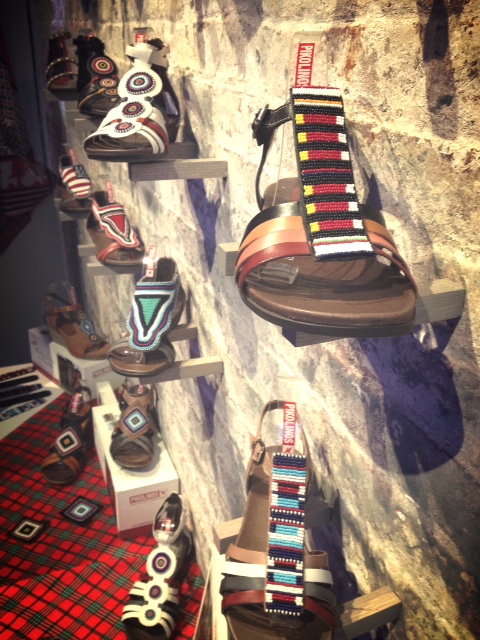
Spain-based footwear and apparel label “Pikolinos” turned to the Maasai people in Kenya to embellish its sandals with gorgeous beadwork. 

Recently, I attended an Africa Fashion Week pop-up shop at Pikolinos in NYC’s hip Meatpacking District. 
In addition to designers being in attendance, such as Missal Mussa (below right) from Zanzibar who is wearing a “Kikoe" type of skirt, there was also a sampling of the fashion to come from this year’s runway shows, such as this shirt above by designer Reuben Reuel De-Mestiks.


I enjoyed all the great design and of course, seeing my pals, including the Founder of Africa Fashion Week, Ms. Adiat Disu (shown with me in left photo above).

In a video entitled, Our Take with Christina Brown & African Fashion Chic," Global Ambassador to Pikolinos, Ms. Bisila Bokoko, explains that the Maasai are a recognized tribe in today’s modern world and this collaboration has enabled Maasai parents to send their children to school, improve relations between husband and wife, and have access to better medical attention, among other reasons.

Mikaila Kim, fashion designer of “Aliakm” shown in the Arise News video, not only designs beautiful garments but she also incorporates images of child soldiers, brass knuckles and guns into her apparel in order to raise awareness about terrible events and realities that should not be forgotten.

Check out www.afwny.com for all the latest on African fashion and watch the Arise TV video to learn more.

Questions/comments?  Post below or email me at fashioncompliance@gmail.com

Keep up with me on Twitter @fashcompliance

Join us on Facebook on the Fashion Compliance page https://www.facebook.com/FashionCompliance

Saturday, June 1, 2013

Obtaining Export Declarations Under the AGOA Agreement

The US has preferential trade agreements with many other countries to promote and increase trade with those nations.

One of these is the “African Growth and Opportunity Act,” otherwise known as the AGOA agreement.

Doreen Mashika Print Clutch Bags - Zanzibar


As it pertains to textiles, its purpose is (in part) to provide for the entry of specific textile and apparel articles free of duty and free of any quantitative limits from the participating countries of sub-Saharan Africa.

For more information about the AGOA, check out these articles:


AGOA Renewal Recommendations Sought by USTR

 For preferential treatment under AGOA, the exporter is required to prepare a certificate of origin and provide it to the importer.  This certificate is something that the importer must request from the exporter to have and keep as part of its record keeping.  The certificate of origin includes information such as

(1)    The contact information for the importer, exporter and producer;

(2)    The basis for which preferential treatment is claimed; and

(3)    A description of the imported merchandise.

Importers are required to have the certificate in their possession at the time of the claim, and to provide it to Customs and Border Protection (CBP) upon request.

Questions/comments?  Post below or email me at clark.deanna@gmail.com
Keep up with me!

On Facebook at https://www.facebook.com/FashionCompliance 

On YouTube at http://www.youtube.com/user/fashioncompliance 

On Tumblr: http://fashioncompliance.tumblr.com

On Twitter @fashcompliance https://twitter.com/fashcompliance 

Tuesday, February 19, 2013

2013 AGOA Countries – Winners and Losers


Currently, there are 39 Sub-Saharan African countries designated as beneficiary countries under the African Growth and Opportunity Act (AGOA).  For a complete list, see below.

President Obama terminated the designations of the Republic of Mali and the Republic of Guinea-Bissau as beneficiary countries under the AGOA agreement at the end of last year.

The one “winner” this year is the emerging country of South Sudan which has been added as the most recent beneficiary to the agreement. 

The practical application of the AGOA is that goods imported into the US from a Sub-Saharan beneficiary country enjoy duty-free treatment, which creates an incentive for US buyers to source products made in these African countries.  Such benefit is currently in effect through September 30, 2015.

The benefit becomes applicable however, only under certain circumstances which do not include simple combining or packing operations, or the mere dilution with water or some other substance that does not materially alter the characteristics of the article.

Rather, the duty-free benefit applies where (1) the imports are the growth, product or manufacture of a designated beneficiary country, and (2) the sum of the cost or value of the materials produced in one or more designated beneficiary countries PLUS the direct costs of processing operations performed there or, in any 2 or more designated members of the same association of countries which is treated as 1 country ((under section 506A of the Trade Act of 1974)) is not less than 35% of the appraised value of such article at the time it is entered.

Here is a complete list of countries.  For more information on the AGOA agreement click here, post below or feel free to email me at clark.deanna@gmail.com

Tweet me @fashcompliance!

AGOA COUNTRIES

Republic of Angola
Republic of Benin
Republic of Botswana
Burkina Faso
Republic of Burundi
Republic of Cameroon
Republic of Cape Verde
Republic of Chad
Union of the Comoros
Republic of Congo
Republic of Côte d’Ivoire
Republic of Djibouti
Ethiopia
Gabonese Republic
Republic of The Gambia
Republic of Ghana
Republic of Guinea
Republic of Kenya
Kingdom of Lesotho
Republic of Liberia
Republic of Malawi
Islamic Republic of Mauritania
Republic of Mauritius
Republic of Mozambique
Republic of Namibia
Republic of Niger
Federal Republic of Nigeria
Republic of Rwanda
Democratic Republic of Sao Tome and
Principe
Republic of Senegal
Republic of Seychelles
Republic of Sierra Leone
Republic of South Africa
Republic of South Sudan
Kingdom of Swaziland
United Republic of Tanzania
Republic of Togo
Republic of Uganda
Republic of Zambia

Tuesday, September 25, 2012

AGOA Renewal Recommendations Sought by USTR


Submit Your Comments By October 11, 2012

For 2012, there are 40 Sub-Saharan African countries which have been designated as beneficiary countries under the African Growth and Opportunity Act (AGOA).  This means that articles, including certain textile and apparel products, made in these countries are eligible upon importation to the US for duty-free treatment.

The US Trade Representative’s Office (USTR) has requested comments in order to develop recommendations on AGOA country eligibility for the 2013 calendar year.

In order to qualify as an AGOA beneficiary country is, among other things, the establishment (or progress towards) a market based economy, governance by the rule of law, the right to due process, and political pluralism.  In addition, economic policies to reduce poverty, a system to combat corruption and bribery, and the protection of internationally recognized worker’s rights are also required.

USTR is also interested in identifying countries and the extent to which child labor is used.

Where the US President determines that a beneficiary country is not making continual progress in meeting the eligibility requirements, he must terminate the designation of the country as a beneficiary of AGOA.

Countries under consideration for 2013 are the State of Eritrea, Democratic Republic of Congo, the Republics of South Sudan, Madagascar, Zimbabwe, Equatorial Guinea and Sudan, Somalia, and the Central African Republic which are not currently beneficiaries under the AGOA.

Public comments in connection with the annual review regarding country eligibility in relation to the above criteria, and also with respect to child labor, are requested for submission online at www.regulations.gov .  Enter the “docket number USTR-2012-0026 on the home page (and click “search”) so that the case can be pulled up. 

You can thereafter find a reference to this notice by clicking “Notice” under the header “Document Type” on the search-results page and click on the link entitled “Submit a Comment.”

If you are unable to make a submission, or have a question related to an attachment or a confidential submission, you may contact Don Eiss, Trade Policy Staff Committee at (202) 395-3475.

All other non-technical or procedural questions should be directed to Constance Hamilton, Deputy Assistant U.S. Trade Representative for Africa, Office of the USTR at (202) 395-9514.

Questions/comments? Post below or email me at clark.deanna@gmail.com

Monday, August 13, 2012

AGOA Third Country Fabric Provision Extended to 2015


With the AGOA’s Favorable Duty Rates, Apparel Importers Can Find Greater Savings When Sourcing From African Countries

The cost of an imported product can vary tremendously when the amount of duty to be paid is factored into the equation, and in the case of apparel, it can run anywhere from an average of $16 to $32 extra for every $100 imported into the US, when made in a foreign country such as China.

The African Growth and Opportunity Act (AGOA) has a provision for imports of apparel when sourced from certain Sub-Saharan African countries, where such clothing originates from either African or US components.  It provides for the duty-free treatment of these products which means rather than paying the additional $16-$32 in duties for every $100 of imported apparel, $0 in duties is instead owed.
Within the AGOA is a “Third Country Fabric” provision which allows fabrics from other countries to be used in the manufacturing process and still qualify for the benefit of “AGOA treatment,” i.e., duty free treatment, of the product.

Last Friday, August 10, 2012, President Obama signed the bill (H.R. 5986) which had been passed on August 2, 2012 by the House and Senate to amend the African Growth and Opportunity Act’s (AGOA) “Third Country Fabric Program” as well as to add South Sudan to the list of countries eligible for designation under the AGOA.

With this passage, apparel importers can now continue to place orders with African manufacturers with the knowledge that these duty savings will continue for the next few years, saving them money, and perhaps saving us consumers some as well.

Questions/comments?  Post below or email me at clark.deanna@gmail.com


Saturday, July 28, 2012

Africa Sourcing and the AGOA Extension


"AGOA Provision Related to the Third Country Fabric Provision Anticipated to Pass Congress Next Week"
    
     --  Staff Member, U.S. Senator Menendez' office in DC

This week I attended TEXWORLD in NYC, which is a textiles and apparel trade show open to those of us in the industry and the public at large. 

While Chinese suppliers made up a large majority, I was pleased to see others hailing from S. Korea, Turkey, and of course, India, among others, as well as a corridor for African sourcing, with a number of vendors from Mauritius, and Origin Africa (http://originafrica.org).

Together at the convention were a series of public seminars, one of which focused on trade and Africa, and particularly on sourcing from Africa. Many companies are interested in sourcing from Africa, and this interest has been steadily growing since the AGOA agreement came into effect.

Currently, we are awaiting the (hoped for and) anticipated passage of a special provision of the African Growth and Opportunity Act (AGOA) which allows fabrics from other countries to be used in the manufacturing process and still qualify for the benefit of “AGOA treatment, ” i.e., duty free treatment, of the product.  For more information on AGOA, check out my other articles here:


I spoke with Senator Menendez’ (NJ state senator) staff in Washington DC yesterday, who assured me that there is a lot of bi-partisan support for the passage of the AGOA provision awaiting passage by the Senate, which involves the continued permission for imports into the US to qualify for the duty-free treatment accorded by the AGOA agreement when fabrics from non-African/non-US countries had been used in the construction of the garment.

I expressed to the staff member that these types of delays make it difficult for businesses to accurately make financial projections in the uncertain commercial environment created when company’s do not know if their cost of importation is going to rise, on average, from anywhere between 10% to 35%.  It therefore, could serve as a deterrent from sourcing from Africa which defeats the whole purpose of a program like the AGOA that is intended to promote increased sourcing from Sub-Saharan Africa.

He assured me that this was known but explained that the AGOA passage was tied up with other trade bills that likewise needed support and which, in their current forms, were not fully supported.

Many people are calling there to express their support for the passage and I encourage you to do the same.  The telephone nos. for Senator Menendez’ office is (202) 224-4744 and the general switchboard in order to be connected to any U.S. Senator’s office is (202) 224-3121.

Feel free to call over there and when connected to a Senator’s office, tell them you would like to speak to someone regarding the “Africa trade bill,” – they’re more likely to understand this comment than stating the "AGOA agreement" - and then express why continued legislative AGOA support is important to you.

Exercise your voice.  Isn’t this what a democracy is all about?

Questions/comments?  Post below or email me at clark.deanna@gmail.com

Thursday, June 21, 2012

11th Session of the African Growth and Opportunity Act (AGOA) Forum


I attended the AGOA Forum last week in Washington, DC, to which I attended primarily out of curiosity and without any particular expectation or affiliation.

I mention the latter because “going down to Washington” in the context of attending a conference specific to a piece of legislation means being surrounded by lawmakers, lobbyists, and a substantial amount of less visible players whom are trying to make sense of the benefits and impact of the legislation.

At the forefront of the Forum was a focus on two (2) exigent issues.

1)  An extension of the 3rd Party Country Fabric Provision, and
2)  An extension of the AGOA itself which is set to expire in 2015


 AGOA usage is premised on a product being of either African or American origin.  If an article derives from either of these origins, then it is eligible for duty-free treatment under the AGOA.

The 3rd Party Provision is an exemption to this rule whereby countries recognized as a “Least Developed Country” can make products which contain components that neither derive from the US nor Africa, but are instead from other “third party” countries.

The ability to continue using Third Party components is set to expire in about 3 months and many believe the extension is necessary.

The AGOA itself expires in 2015.  Many proponents believe an extension must be implemented now.  They are right.

Or, business needs to know now that it will not be. 

What is needed now is an answer one way or the other.

Any businesswoman attempting to make reasonable financial projections cannot reasonably do so with this uncertainty of an AGOA Extension.  It’s risk enough to consider setting up in an emerging economy but to try and do so in a setting where your basic cost of doing business cannot be calculated due to shifts in landed duty costs of nearly 20%, if we take the case of the ubiquitous cotton t-shirt as an example, is nothing short of a waste of time.

Something business owners already have little of - time that is.

If Congress thinks AGOA is a mere “handout” type of reformative development tool that is a waste of taxpayer dollars then now is the time to inform the public that it will not be continued so that the private sector can made realistic business projections.

Growing an economy in the face of government caused uncertainty during a time of recession is counterproductive.  This is precisely what Congress is doing in its failure to vote one way or the other to extend the AGOA.

Make a decision so that those of us who want to do business in Africa can do so in a realistic commercial environment.

Questions/comments?  Post below or email me at clark.deanna@gmail.com.