Showing posts with label importers. Show all posts

Friday, August 7, 2015

Have You Heard That GSP is Back?

The Generalized System of Preferences (GSP) allows for the duty-free treatment of certain goods imported directly from designated beneficiary countries for specific periods of time.


While the GSP had expired on July 29, 2015 it was renewed through December 31, 2017, with a retroactive application between August 1, 2013 and July 28, 2015.  

This means that US Customs is now accepting claims for GSP duty-free merchandise when imports are entered into the US and they are now processing refunds on duties paid, without interest, on merchandise entered during the period that the program had lapsed (i.e., between August 1, 2013 and July 28, 2015) where entries had been filed electronically. Customs is therefore, automatically liquidating, or reliquidating, eligible formal and informal entries made during this lapsed time.

Where entry had not been made electronically however, including entries made by mail, or those by travelers, requests for liquidation must be made by December 28, 2015 pursuant to the procedures set forth in US Customs website under the "GSP Refund Process."

The good news is that now entry filers can  resume filing entry summaries without the payment of estimated duties on  GSP eligible entry summaries. It's also good for those planning importations as realistic price and other projections can be made for, at least, the short term through 2017.

Questions/comments?  Feel free to post below.

Keep up with me at www.fashioncompliance.com or:
On Facebook at www.facebook.com/FashionCompliance by *liking* the page
On Twitter @fashcompliance

Thursday, July 24, 2014

CPSC Proposes Amending GCC Rules


Importers:  Did you know that the Consumer Product Safety Commission (CPSC) has proposed to amend the existing rule on the General Certificate of Conformity (GCC)?


Amendments including the requirement for the electronic filing of GCCs for regulated imported consumer products with U.S. Customs and Border Protection (CBP) at the time of filing the CBP entry, or the time of filing the entry and entry summary, are just some of the proposed amendments. 
Not keen on this idea?  You are in luck! 
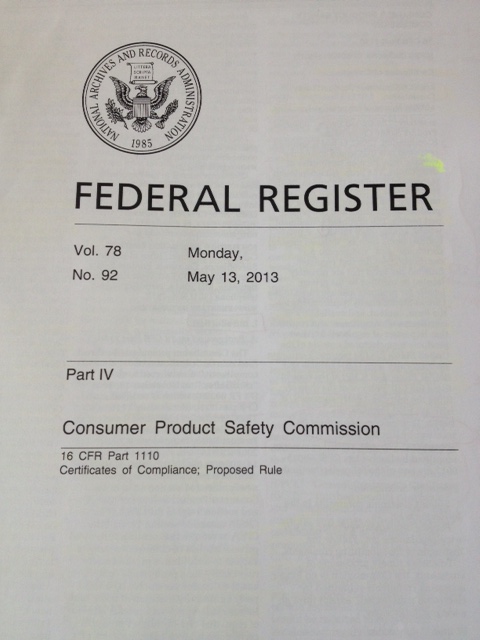
 The CPSC recently voted to hold a workshop and seek additional public comments on aspects of its proposed rule on Certificates of Compliance, which the Commission first published on May 13, 2013.

Interested parties are invited to participate in, or attend the workshop, and to submit written comments.

The workshop will be held from 9 a.m. to 4 p.m. on Thursday, September 18, 2014 in the CPSC Hearing Room, 4th Floor of the Bethesda Towers Building, 4330 East West Highway, Bethesda, MD 20814.

Registration is now open using the following link, where you can also read the  formal notice by CPSC:

Questions or comments? Post below or email me at clark.deanna@gmail.com

Keep up with me at www.fashioncompliance.com or:


On Twitter @fashcompliance

Friday, July 26, 2013

Retailers and Importers May be Subject to More CPSC Certificate Requirements?


Ever Heard of a “Finished Product Certificate?”   Or a “Component Part Certificate?”
 

These are but two (2) of a list of new definitions that the Consumer Product Safety Commission (CPSC) is proposing to implement, and with newly defined terms of course, come new requirements.

Certification by a private labeler for products manufactured in the US is one of the proposed new rules, as well as the requirement by an importer of regulated finished products manufactured outside of the US to file its mandatory certificate at the time of filing the entry (and entry summary, if filed together).
Last Weekend To Get Your Comments in to CPSC on Certificates of Compliance

It is your last weekend to prepare and submit your comments related to these proposed rules as written comments must be received by  Monday, July 29, 2013.

To read more about this and for the links on where to electronically submit your comments, check out the Federal Register notice announcing this proposed rule which may be found at 78 FR 28080 or by clicking here.

Questions/comments?  Post below or email me at clark.deanna@gmail.com
Join me:
On Facebook at https://www.facebook.com/FashionCompliance

On YouTube at http://www.youtube.com/user/fashioncompliance

On Tumblr: http://fashioncompliance.tumblr.com/

On Twitter @fashcompliance https://twitter.com/fashcompliance


Thursday, March 21, 2013

Know Someone Who Buys Fakes? You May Want to Give Them a Word of Advice – DON’T!

Not surprisingly, fashion merchandise had the highest figures (measured by the manufacturer’s suggested retail price or “MSRP”) in terms of counterfeit and pirated goods that importers, large and small, attempted to bring in to the US which were seized at the border last year.


Handbags/wallets were the top category at 40%, watches/jewelry came in at “second place” at 15% and wearing apparel/accessories rounded out the top 3 categories at 11%, for a total of 66% of all seized commodities.  These same categories were the 2011 top three types of merchandise as well, albeit at a smaller cumulative figure of 45%.

US Customs is the agency responsible for protecting intellectual property (“IP”) rights holders and American consumers from IP theft on goods entering the country.  Pirated and counterfeit goods pose a threat to America’s economic vitality and the health and safety of its consumers.

Other victims include those whose identities are stolen in the pursuit of con artists attempting to get their counterfeit imports into the US, and who therefore disguise themselves as legitimate businesses and even hold themselves out as that entity when handling transactions.  These victims can include customs brokers, importers and other participants in the international trade supply chain.
 An additional less visible victim are the children who end up being the labor behind these imitation products.
The internet has fueled the explosive growth of small packages of pirated and counterfeit merchandise shipped through express carriers, like FedEX or DHL (unbeknownst to them, of course), and the mail.  Not only is US Customs stopping these shipments at the border but they are also participating in the shutdown of websites that are involved in the trafficking of these goods.
Know someone who buys fakes?  You may want to give them a word of advice – DON’T!

Questions/comments?  Post below or email me at fashioncompliance@gmail.com

Keep up with me:

On Facebook at https://www.facebook.com/FashionCompliance

On YouTube at http://www.youtube.com/user/fashioncompliance

On Tumblr: http://fashioncompliance.tumblr.com/

On Twitter @fashcompliance https://twitter.com/fashcompliance

Wednesday, January 2, 2013

New Year, New Diet, and New Customs Rule on $2500 “Informal Entry” Limit


It’s not uncommon to find people engage in *new* things, such as a new workout routine, new diet, or maybe even a new boyfriend/girlfriend (hey, why not?) at the start of a new year.

Like people, federal agencies also start things at the new year as US Customs is doing with it’s new dollar (USD) limit for which merchandise being imported into the US may reach in order to qualify for an “informal entry.” 

For more about entry, check out this article here.

The informal entry limit is going from $2,000 to $2,500 and when an importation qualifies as an ‘‘informal entry,” it eliminates the need for a surety bond, expedites the customs clearance process, and reduces another required charge, known as the Merchandise Processing Fee (MPF) to $2 (assuming the entry is filed electronically).

New Rule Effective 07-Jan-2013

Reasons for this increase are to mitigate the effects of inflation between the United States and Canada and to harmonize the value thresholds for expedited customs clearance to $2,500 from the current levels of $2,000 for the United States and $1,600 for Canada. 

For any merchandise valued over $2,500, formal entry is required and importers must provide a surety bond (more info. on this can be found here), complete Customs form 7501 (instructions here), and pay a minimum of $25 in MPF. 
 Unless exempt under a free trade agreement, and in addition to any duty or tax owed, merchandise requiring a formal entry is subject to a 0.3464 percent ad valorem MPF, which may be no greater than $485 and no less than $25.  Formal entry also requires detailed information regarding the import transaction as well as commercial documents pertaining to the transaction.

Of course, based on his/her discretion, a port director, may always require an importer to file a formal entry.

For more information, you can read the entire final rule on the informal entry limit in the Federal Register (73 FR 72715) here.

Questions/comments?  Post below or email me at clark.deanna@gmail.com

Follow me on Twitter - @fashcompliance
HAPPY NEW YEAR!

Monday, August 13, 2012

AGOA Third Country Fabric Provision Extended to 2015


With the AGOA’s Favorable Duty Rates, Apparel Importers Can Find Greater Savings When Sourcing From African Countries

The cost of an imported product can vary tremendously when the amount of duty to be paid is factored into the equation, and in the case of apparel, it can run anywhere from an average of $16 to $32 extra for every $100 imported into the US, when made in a foreign country such as China.

The African Growth and Opportunity Act (AGOA) has a provision for imports of apparel when sourced from certain Sub-Saharan African countries, where such clothing originates from either African or US components.  It provides for the duty-free treatment of these products which means rather than paying the additional $16-$32 in duties for every $100 of imported apparel, $0 in duties is instead owed.
Within the AGOA is a “Third Country Fabric” provision which allows fabrics from other countries to be used in the manufacturing process and still qualify for the benefit of “AGOA treatment,” i.e., duty free treatment, of the product.

Last Friday, August 10, 2012, President Obama signed the bill (H.R. 5986) which had been passed on August 2, 2012 by the House and Senate to amend the African Growth and Opportunity Act’s (AGOA) “Third Country Fabric Program” as well as to add South Sudan to the list of countries eligible for designation under the AGOA.

With this passage, apparel importers can now continue to place orders with African manufacturers with the knowledge that these duty savings will continue for the next few years, saving them money, and perhaps saving us consumers some as well.

Questions/comments?  Post below or email me at clark.deanna@gmail.com


Tuesday, June 26, 2012

International Trade and Human Rights


PBS aired a news piece recently that spoke to the human rights abuses in textiles factories in Cambodia. 

How do human rights abuses affect international trade?

 Maltreatment of apparel workers in the developing world as well as here in the US is common practice and has been for decades. 

How do we as a country that prides itself on labor laws and OSHA regulations (the "healthy workplace" standards in the US) so easily ignore this reality when we as consumers can have a direct impact in trade and overseas production if we speak with our wallets?

Doesn’t money talk?

Indeed it does, as many licensors know who place manufacturing requirements in its contracts with importers in an attempt to improve the working conditions of overseas laborers.  (See my article here for more information.)

Many importers of both unfinished and finished products, as well as agribusiness, see Africa as the “new frontier”. 

What I would like to know is:  Will we do it the “right way?”

That is, in a place with loose regulations (at best) will we – those of us going into the many countries that make up Africa – take advantage of the people and their land?

Or, will we create a business environment where human life and dignity are respected and sustainable production is expected, such that the health and welfare of both the people and the environment are respected?

In my view, the latter is the only answer, not only from an ethical standpoint but from that of a sustainable business model. 

Questions/comments?  Post below or email me at clark.deanna@gmail.com

Tuesday, July 19, 2011

New CPSIA Lead Content Limits Announced

Effective Date: August 14, 2011

Starting next month, importers, manufacturers, retailers and distributors of children’s products will be required to certify that their products conform to the Consumer Product Safety Improvement Act’s (CPSIA) requirement that children’s products contain no more than 100 ppm of total lead content.

Testing must be undertaken by a third party test lab which is certified by the Consumer Product Safety Commission, and lists of approved testing companies is available on its website here.

Both the testing of, and compliance with, these federal guidelines with respect to inaccessible internal parts of children’s products and certain component parts of children’s electronic devices are not mandated under this new rule.

This requirement is not to be confused however, with the levels set for lead paint or other surface coatings placed on children’s products. That limit of a total lead level of .009% remains the same as it has been the case since August 14, 2009.

Through the CPSIA, Congress seeks to reduce the exposure to lead on children 12 years of age and under, as lead is a heavy metal that is especially toxic to children. It has been associated with causing brain damage, hearing impairment, lowered learning levels, and at high levels can be fatal.

Questions/comments? Post below or email me at clark.deanna@gmail.com


Monday, February 21, 2011

The Fashion Industry and Accountability for the Basic Human Rights of Foreign Laborers

Fall 2011 New York Fashion Week which has just wrapped up here in NYC, has increasingly brought more issues to the forefront, including the currently trendy dialogue around “sustainable fashion” along with the well known - yet still undealt with - issue of eating disorders that many models struggle with.

One lesser known and far less glamorous issue has to do with foreign labor in the fashion industries. Textiles, and hence apparel, are made primarily overseas using labor that is less expensive than could be found in the United States. That obviously is no secret, however, disproportionately high working hours, wages that barely cover the rent let alone providing an adequate standard of living, hazardous working conditions, child labor and forced labor are all realities that exist in the industry as well.

Designers or license holders who rely on foreign labor to manufacture products with their logos on it (see my previous post for an explanation about licenses, license holders and royalties) have, in my view, a duty of accountability to ensure basic human rights towards laborers all the way down the line back to the factory.

This concept of importer oversight “down the line” is not unusual within the international trade community. An example of this is US Customs C-TPAT (Customs-Trade Partnership Against Terrorism) program, which causes importers to “vet” their supply chain for security purposes all the way back to the factory in exchange for a more expeditious customs clearance. As a result of this program, changes to factories such as adequate ventilation, locks on doors and basic sanitation upgrades have been implemented due to an importer’s demands that such changes be put into place.

While industry standards grossly lack foreign labor accountability, I am pleased to report that some licensor’s do in fact, require not just those licensee’s who import products with their logos to maintain certain labor standards, but they likewise require that those importers have their manufacturers agree to these terms as well.

To give you an idea of some of these contract terms that protect laborer rights and attempt to provide an “ethical code of conduct” if you will, here are some sample clauses below:

* Child Labor: Licensee and its Suppliers will not purchase products or components thereof manufactured by persons younger than fourteen (14) years of age or younger than the age of completing compulsory education in the country of manufacture where such age is higher than fourteen (14). Licensee and its Suppliers further acknowledge and agree that they will not use any child labor in the manufacturing, packaging or distribution of Licensor merchandise. In no case shall any child younger than fourteen (14) years of age or younger than the age of completing compulsory education in the country of manufacture where such age is higher than fourteen (14) be employed in the manufacturing, packaging, sales or distribution of Licensor merchandise.

* Forced Labor: Licensee and its Suppliers will not purchase products or components thereof from suppliers that use forced labor, prison labor, indentured labor or exploited bonded labor, or permit their suppliers to do so. Licensee and its Suppliers acknowledge and agree that they will only employ persons whose presence is voluntary and that they will not utilize any forced or involuntary labor, whether prison, bonded, indentured or otherwise.

* Contract Labor: Licensee and its Suppliers shall not use workers obligated under contracts which exploit them, which deny them the basic legal rights available to people and to workers within the countries in which they work or which are inconsistent with the principles set forth in this Code of Conduct Legal and Ethical Business Practices: Licensee and its Suppliers must fully comply with all applicable local, state, federal, national and international laws, rules and regulations including, but not limited to, those relating to wages, hours, labor, health and safety, and immigration.

* Work Hours: Licensee and its Suppliers shall not require their employees to work more than the limits on regular and overtime hours allowed by the law of the country of manufacture. Except under extraordinary business circumstances, Licensee's and its Suppliers' employees shall be entitled to one (1) day off in every seven (7) - day period. Licensee and its Suppliers must inform their workers at the time of their hiring if mandatory overtime is a condition of their employment. Licensee and its Suppliers shall not compel their workers to work excessive overtime hours.

* Wages and Benefits: Licensee and its Suppliers recognize that wages are essential to meeting employees' basic needs. Licensee and its Suppliers shall pay employees at least the minimum wage required by local law regardless of whether they pay by the piece or by the hour and shall provide legally mandated benefits.

* Overtime Compensation: Licensee and its Suppliers' employees shall be compensated for overtime hours at such premium rate as is legally required in the country of manufacture or, in countries where such laws do not exist, at a rate at least equal to their regular hourly compensation rate.

* Freedom of Association: Licensee and its Suppliers shall recognize and respect the right of employees to freely associate in accordance with the laws of the countries in which they are employed.

* Nondiscrimination: Licensee and its Suppliers shall not subject any person to discrimination in employment, including hiring, salary, benefits, advancement, discipline, termination or retirement, on the basis of gender, race, religion, age, disability, sexual orientation, nationality, political opinion, or social or ethnic origin.

* Harassment or Abuse: Licensee and its Suppliers must treat their employees with respect and dignity. No employee shall be subject to physical, sexual or psychological harassment or abuse.
Licensee and its Suppliers acknowledge and agree not to use corporal punishment or threats of violence.

* Health and Safety: Licensee and its Suppliers shall provide a safe and healthy working environment to prevent accidents and injury to health arising out of, linked with, or occurring in the course of work or as a result of the operation of employer facilities. Licensee and its Suppliers further acknowledge and agree that they will comply with all applicable workplace conditions, safety and environmental laws.

Clauses like these are an illustration of a movement in the right direction, however, much more can be done to prevent incidents of child labor, such as by providing the parents with livable wages.

Questions/comments? Post below or email me at clark.deanna@gmail.com

Thursday, January 27, 2011

Stay of Enforcement Lifted on CPSC Flammability Standards

Following a unanimous vote by the U.S. Consumer Product Safety Commission (CPSC), the stay of enforcement on certification for compliance with the flammability standards for non-children's products has been lifted in the following categories:

• Clothing textiles
• Carpets and rugs
• Vinyl plastic film


This means in everyday language, that an importer who fails to certify that CPSC flammability standards have been met on imported merchandise will now be subject to penalties which can exceed well over $100,000 USD.

Starting yesterday (January 26, 2011), an importer will no longer be “forgiven” when it fails to certify that an importation is compliant with CPSCs flammability rules. The compliance certificate indicating this is known as a General Conformity Certificate or “GCC.”

CPSC concluded in 2009 that when certain fabrics have not been treated with the inclusion of substances that could result in the addition of lead into the fabric, lead content testing was no longer required where it was 100% of, or any blend of, the following textiles.

1. Natural fibers, whether dyed or undyed, including cotton, ramie, linen, silk, alpaca, among others; and,

2. Manufactured fibers, whether dyed or undyed, including polyester, spandex, nylon, acrylic and rayon, among others.

Keep in mind that a GCC is still mandatory even where the underlying textile is exempted from CPSC requirements.
While the underlying testing of these fabrics is no longer required, manufacturers and importers still remain responsible for

(a) Providing a GCC with each shipment,
(b) Verifying that the product or material has not been altered or modified so as to cause lead to enter the material or product, and
(c) Assuring for themselves that the fabric is indeed exempt.

GCCs and copies of the test results upon which certification is based must be kept for 3 years. It also must be provided in a timely manner upon request by CPSC, or an importer can find itself subject to a penalty under the premise of having made a false guaranty. As the certifier that merchandise is compliant with CPSC rules, an importer must:

1. Be in possession of the original, or a copy of, the test certificate upon which the GCC is based, and

2. Retain the test certificate together with the original GCC for a minimum of 3 years after the production date.

A GCC must accompany the product whether imported or manufactured in the United States and be furnished to the product's distributors and/or retailers as these companies must also supply GCCs for their products to CPSC upon request.

CPSC requires that the GCC “accompany” a shipment [73 FR 68328, 11/24/08], and it permits a number of methods for doing so, including electronic “accompaniment.”

While the GCC may be made available online, given the reality of facilitating the movement of cargo and U.S. Customs’ physical handling of it, the agency looks for certain records as being included with a shipment. Therefore, its physical inclusion within the shipment is recommended.

Needless to say, it is critical that CPSC flammability rules and regulations are complied with now that enforcement activity will commence and penalty amounts have so tremendously increased. More information about factors CPSC may consider in assessing a penalty can be found at 16 CFR Part 1119, published in 74 FR 45101.

Questions/comments? Post below or email me at clark.deanna@gmail.com

Sunday, May 16, 2010

2010 World Trade Week NYC

Join me and other OWIT-NY members this Tuesday for a networking cocktail hour to celebrate World Trade Week. You will connect with business owners and professionals, all active in the global arena.

Date: Tuesday May 18, 2010.
Time: 6:00 pm to 8:00 pm
Venue: Public House Restaurant, 140 East 41 Street b/w Lexington and Third Avenue, NYC


The mission of World Trade Week NYC is to underscore and promote the importance of international trade to the New York City metropolitan area economy. New Yorkers depend heavily on international commerce for their jobs, standard of living, and the myriad goods and services available to its diverse population. World Trade Week NYC is part of an annual nationwide celebration of international trade observed by business, and trade-related organizations across the United States during the third week of May. For more information on World Trade Week 2010 events, please click here.

The Awards Breakfast, scheduled for May 17th, recognizes outstanding companies that have grown through global expansion. OWIT-NY will be exhibiting at the breakfast for the first time, as this is the great market place to meet fellow international traders and learn the latest trends in our industry. I will be at the OWIT-NY booth and the Awards Breakfast. Here is the address:

Baruch College
55 Lexington Ave., 14th Floor
New York, New York

Hope to see you there!