Showing posts with label entry. Show all posts

Friday, August 7, 2015

Have You Heard That GSP is Back?

The Generalized System of Preferences (GSP) allows for the duty-free treatment of certain goods imported directly from designated beneficiary countries for specific periods of time.


While the GSP had expired on July 29, 2015 it was renewed through December 31, 2017, with a retroactive application between August 1, 2013 and July 28, 2015.  

This means that US Customs is now accepting claims for GSP duty-free merchandise when imports are entered into the US and they are now processing refunds on duties paid, without interest, on merchandise entered during the period that the program had lapsed (i.e., between August 1, 2013 and July 28, 2015) where entries had been filed electronically. Customs is therefore, automatically liquidating, or reliquidating, eligible formal and informal entries made during this lapsed time.

Where entry had not been made electronically however, including entries made by mail, or those by travelers, requests for liquidation must be made by December 28, 2015 pursuant to the procedures set forth in US Customs website under the "GSP Refund Process."

The good news is that now entry filers can  resume filing entry summaries without the payment of estimated duties on  GSP eligible entry summaries. It's also good for those planning importations as realistic price and other projections can be made for, at least, the short term through 2017.

Questions/comments?  Feel free to post below.

Keep up with me at www.fashioncompliance.com or:
On Facebook at www.facebook.com/FashionCompliance by *liking* the page
On Twitter @fashcompliance

Friday, November 7, 2014

How Do You Classify Sleepwear vs. Loungewear for Customs Purposes?

It's getting chilly outside, and as we bundle up on the outside we're doing the same indoors too. 
But which do you go for - sleepwear or loungewear?


I suppose as long as it's cute, it really doesn't matter, but for US Customs classification purposes it absolutely matters.  So how do you distinguish between the two so that proper disclosures are made to CBP upon entry?

Check out our video to learn more about some of these differentiating factors, and for more fashion and international trade, we invite you to head over to our Fashion Compliance YouTube channel for more easy-to-digest international trade fun.

We invite you to join us on Facebook by *liking* our page at www.facebook.com/FashionCompliance

Have questions or comments? 

Learn more at www.fashioncompliance.com or
Tweet us @fashcompliance on www.twitter.com or
Email us at clark.deanna@gmail.com


Friday, July 26, 2013

Retailers and Importers May be Subject to More CPSC Certificate Requirements?


Ever Heard of a “Finished Product Certificate?”   Or a “Component Part Certificate?”
 

These are but two (2) of a list of new definitions that the Consumer Product Safety Commission (CPSC) is proposing to implement, and with newly defined terms of course, come new requirements.

Certification by a private labeler for products manufactured in the US is one of the proposed new rules, as well as the requirement by an importer of regulated finished products manufactured outside of the US to file its mandatory certificate at the time of filing the entry (and entry summary, if filed together).
Last Weekend To Get Your Comments in to CPSC on Certificates of Compliance

It is your last weekend to prepare and submit your comments related to these proposed rules as written comments must be received by  Monday, July 29, 2013.

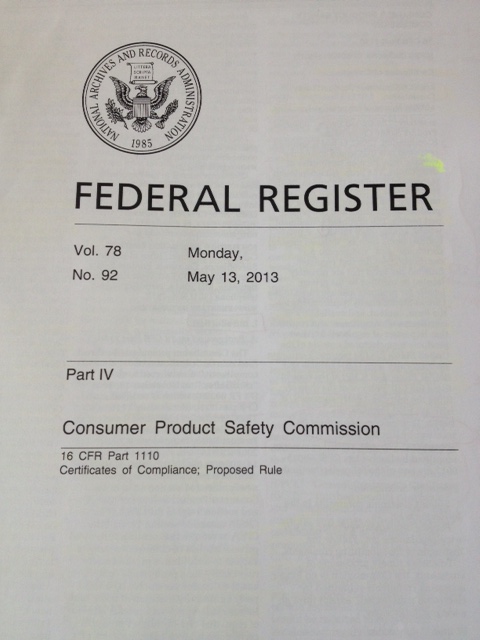
To read more about this and for the links on where to electronically submit your comments, check out the Federal Register notice announcing this proposed rule which may be found at 78 FR 28080 or by clicking here.

Questions/comments?  Post below or email me at clark.deanna@gmail.com
Join me:
On Facebook at https://www.facebook.com/FashionCompliance

On YouTube at http://www.youtube.com/user/fashioncompliance

On Tumblr: http://fashioncompliance.tumblr.com/

On Twitter @fashcompliance https://twitter.com/fashcompliance


Thursday, January 31, 2013

What Is a "Sale?" (US Customs' View of It, That Is...)

Here in NYC we are wrapping up the season of winter sales (which, as an aside, have been pretty fun to shop), but this has nothing to do with what a “sale” is when it comes to importation as this concept does not relate to discounted merchandise.

A “sale” in Federal Court language is the transfer (or “passage”) of title from one party to another for “consideration.”


In everyday language, it means where I obtain something belonging to someone else in exchange for something else.  For example, trading money (i.e., purchasing) for a cashmere sweater from Bloomingdale’s, which is likely to be discounted now given the winter sales season but alas, I digress…


Having a “sale” is relevant for valuation purposes of an imported product.  This is because duties are collected on the value of merchandise which is typically identified in a commercial invoice.  Where a part of the product is supplied by the importer and the value for this is not accounted for, it can lead to an incorrect declaration and hence, an inaccurate calculation on the collection of customs duties which must be paid to US Customs when goods are entered into the US.

A sale must therefore be identifiable.

While US Customs uses no single factor as evidence, acceptable proofs of such exchange include payment by check, bank transfer, or such other commercially acceptable means of payment.  The payment must also be made for the imported merchandise at issue.  Therefore, a general transfer of money from one corporate entity to another – which cannot be linked to a specific import transaction – would not likely demonstrate the passage of title.

Lastly, when deciding whether a sale happened or not, US Customs will look at whether the circumstances of the transaction indicate that the parties are functioning as buyer and seller.  While this is normally not difficult to identify when unrelated parties are doing business (even at the most basic level like what you would find on www.craigslist.org), when the parties are related such a clearly identifiable transaction isn’t always clear, which could lead to inaccurate value declarations as described above.

Questions/comments?  Post below or email me at clark.deanna@gmail.com

Follow me on twitter @fashcompliance
ciao ciao!

Wednesday, January 2, 2013

New Year, New Diet, and New Customs Rule on $2500 “Informal Entry” Limit


It’s not uncommon to find people engage in *new* things, such as a new workout routine, new diet, or maybe even a new boyfriend/girlfriend (hey, why not?) at the start of a new year.

Like people, federal agencies also start things at the new year as US Customs is doing with it’s new dollar (USD) limit for which merchandise being imported into the US may reach in order to qualify for an “informal entry.” 

For more about entry, check out this article here.

The informal entry limit is going from $2,000 to $2,500 and when an importation qualifies as an ‘‘informal entry,” it eliminates the need for a surety bond, expedites the customs clearance process, and reduces another required charge, known as the Merchandise Processing Fee (MPF) to $2 (assuming the entry is filed electronically).

New Rule Effective 07-Jan-2013

Reasons for this increase are to mitigate the effects of inflation between the United States and Canada and to harmonize the value thresholds for expedited customs clearance to $2,500 from the current levels of $2,000 for the United States and $1,600 for Canada. 

For any merchandise valued over $2,500, formal entry is required and importers must provide a surety bond (more info. on this can be found here), complete Customs form 7501 (instructions here), and pay a minimum of $25 in MPF. 
 Unless exempt under a free trade agreement, and in addition to any duty or tax owed, merchandise requiring a formal entry is subject to a 0.3464 percent ad valorem MPF, which may be no greater than $485 and no less than $25.  Formal entry also requires detailed information regarding the import transaction as well as commercial documents pertaining to the transaction.

Of course, based on his/her discretion, a port director, may always require an importer to file a formal entry.

For more information, you can read the entire final rule on the informal entry limit in the Federal Register (73 FR 72715) here.

Questions/comments?  Post below or email me at clark.deanna@gmail.com

Follow me on Twitter - @fashcompliance
HAPPY NEW YEAR!

Friday, October 12, 2012

New US Customs “Centers for Excellence and Expertise” (CEE)


I attended a US Customs webinar yesterday that explained how the agency is in the process of setting up new “Centers for Excellence and Expertise” (CEE).  These centers – which are virtual – are intended to bring existing expertise together in order to facilitate trade on the part of US Customs and to align its procedures with modern business practices.

Of greater significance however, is that US Customs intends to assign each importer with an account at a CEE to route entry summaries through and to use these virtual environments to move non-revenue collection activity to a CEE for handling protests, the review of prior disclosures and other activities.  Revenue collection however, will continue to be done at the port of entry.

The creation of CEEs are part of US Customs’ “trade transformation efforts,” which also includes an overhaul of 19 CFR Part 111, which are the customs brokers regulations.

CEEs are meant to serve as an information resource for the importing community, be it a large or small importer or broker, US Customs itself, or another government agency.  Customs stated that it has created CEEs by industry in order to focus on industry-specific issues so it can better meet the challenges for that industry.  Unfortunately, with such few and broad categories (listed below) in relation to the thousands of types of imported merchandise, it is questionable as to how well this intention will be met.

The goals of the CEE are:

1)      To facilitate legitimate trade through effective risk management and to “segment” risk so as to get the “good actors” out of the way in order to focus on the riskier participants,
2)      To increase industry-based knowledge within Customs and to better understand the unique practices within an industry, and
3)      To enhance enforcement efforts and to partner with industry stakeholders in order to understand and address industry risks.

As it stands, nine (9) industry groups were identified by Customs for which nine (9) CEEs are to be created.  Four (4) of them have already opened, listed as the first four (4) in the list below, and importers are already welcome to solicit participation in one of them.
Open CEEs:

1)      Electronics (Long Beach, CA)
2)      Pharmaceutical Health and Chemicals (New York)
3)      Automotive and Aerospace (Detroit, MI)
4)      Petroleum, Natural Gas and Minerals (Houston, TX)

Unopened Centers:
5)      Apparel, Footwear and Textiles
6)      Base Metal and Machinery
7)      Consumer Products and Mass Merchandising
8)      Industrial and Manufacturing Materials
9)      Agriculture and Prepared Products

For more information, you can check out this Federal Register Notice at 77 FR 52048 dated August 28, 2012, access a .pdf version here), or email US Customs directly at cee@cbp.dhs.gov.

Questions/comments?  Post below or email me at clark.deanna@gmail.com
Thursday, August 30, 2012

Translating Numbers – Converting a “Compound Duty Rate” to an Equivalent “Ad Valorem” Duty Rate


Every type of imported product has a tariff classification number to identify it and a corresponding numerical figure that represents its duty rate.

The duty rate for most products is represented as a percentage value such as 19.7%.  When it is a percentage, a duty rate is referred to as an “Ad Valorem” rate of duty.

The concept of a duty rate is relatively simple except for when a product has a “compound rate” of duty, such as a watch.  Under the tariff, an example of a watch’s rate of duty is broken out into multiple components, four (4) in fact, in the following example (HTSUS* 9102.11.10):

Movement – 0.44¢ (cents)
Band/strap or bracelet – 14.0%
Case – 6.0%
Battery – 5.3%

On certain occasions however, there is a need to convert a compound rate of duty to a percentage, or Ad Valorem one, such as in the case of dinnerware sets classifiable under HTSUS Heading 8215.

As described by US Customs**, to convert a compound rate to an equivalent Ad Valorem rate, one.

(i)                  obtains the unit value of each article,
(ii)                applies the article’s listed compound rate of duty, and
(iii)               calculates the “equivalent Ad Valorem rate” by computing the percentage of the article’s value that the compound rate of duty amounts to. 

For example, suppose that a set classified in subheading 8215.20.0000, includes a knife that is separately classifiable in subheading 8211.91.5000.  The applicable rate of duty for the knife is “0.7¢ + 3.7%,” a compound duty rate.

Suppose that there are four knives included in the set and their total value is 32¢.  To obtain the unit value of a knife (i.e., the value of one knife), we divide 32¢ by 4 which equals 8¢.

Now, we apply the knife’s listed compound duty rate.  Plugging 8¢ into the duty rate, we get 0.7¢ + 3.7%(8¢).  This equals .996¢ per knife, which amounts to 12.45% of the knife’s value (i.e., .996 is 12.45% of 8¢). 

Therefore, 12.45% is the knife’s equivalent Ad Valorem rate. 

Sounds simple?  I didn’t say it would be, though it doesn’t have to be complicated either.  Give it a try!

Questions/comments?  Post below or email me at clark.deanna@gmail.com

* HTSUS stands for the "Harmonized Tariff Schedule of the United States" which can be found at the US International Trade Commission's website at www.usitc.gov

**Reference is made to HQ967248 (12/22/04)

Tuesday, June 7, 2011

Navigating the Importation Process - Tips for the New Importer

I remember one of my best friends telling me in college that she thought it would be fun to have an import business where of course, she got to do the traveling to find all of the wonderful treasures that she would sell in her shop.

I know that back then, we never could have imagined that there would be so many obscure rules, such as that articles made of wood might require a declaration from the USDA, or that beaded jewelry made of seeds from exotic forests might be subject to FDA regulations.

After all, how does an importing entrepreneur even know where to begin in terms of compliance with the law when most have little idea about the complexities of importing?

Nowadays, thanks to search engines like Google – which did not exist when we were in college (zoiks!) – getting information about importing is a much simpler endeavor. This of course, is both good and bad.

It is good in that basic importing information may be found online, but of course, not all information out there is equally correct.

The down side however, is that there is a presumption that a responsible importer would have been able to seek out information that pertained to their type of import and therefore ought to have dotted all of their proverbial “I’s” and crossed their “T’s.”

A failure to do so can lead to an accusation of negligence in the event of an importing “hiccup” or even worse, an allegation of fraudulent activity.
So where does a new importer begin?

Like people entering the country, the border is the front line of imported merchandise, and US Customs and Border Protection has jurisdiction over what is permitted to enter – and remain – in the country.

A few helpful links include the web pages on US Customs’ website (www.cbp.gov) under the “Trade” tab. Within this section is a link called "Basic Importing and Exporting" which further leads to information on US Customs import requirements as well as other federal agency requirements.

There is also a rather lengthy US Customs guide entitled “Importing into the United States – A Guide for Commercial Importers” as well as numerous “Informed Compliance” publications which offer both general importing information such as on the “Entry” of merchandise, and Tariff Classification, as well as more import specific information, such as on Eyewear, Textile and Apparel Rules of Origin, and Footwear.

More tips for new importers and exporters can be found here.

Questions/comments? Post below or email me at clark.deanna@gmail.com

Thursday, December 30, 2010

Customs Entry and Filing Procedures

Every importer knows that a lack of good entry procedures can lead to delayed, detained, or even seized shipments. Inadvertent classification declarations that lead to additional duty liability are common as well.

Action taken by Customs when this occurs may result in, for example, the issuance of a Notice of Action (Customs Form 29) whereby it applies what it believes is the correct HTSUS number and notifies the importer of the additional duties that must be paid.

The late payment of duties is another common occurrence, so much so that Customs has what I like to call a “parking ticket” approach to addressing the oversight of late payment. This is typically done through an assessment of liquidated damages whereby Customs demands a seemingly large amount of money, or alternatively, allows you to pay a much smaller amount, say $250, provided that it is paid within 60 days of the date of Customs’ notice to the importer. This is known in Customs-ease as the “Option 1” mitigation alternative to payment of the larger liquidated damage amount. This payment may be made through the customs broker or importer.

To give you an overview of Entry Filing, think about it as a two step process. (19 CFR Part 141).

Step 1: Filing an entry that seeks the Immediate Delivery/Release of the shipment (CF 3461), which is done with the shipment Waybill, commercial invoice (or a pro forma invoice when the commercial invoice cannot be produced), packing lists, and such other documentation as is necessary to determine merchandise admissibility.

Keep in mind that while required to produce certain documentation to the Customs Broker, and to Customs on request, most information is transmitted to Customs electronically through the Automated Broker Interface (ABI).

This must be done within 15 calendar days after the arrival of the importing carrier, but will usually be done earlier on vessel shipments (5 days before arrival) and on air shipments, “wheels up” from the foreign airport.

Step 2: Filing a ‘Follow Up’ Entry Summary (CF 7501) that provides greater detail about the shipment along with the duties preliminarily determined to be due (estimated duties.).

This must be filed within 10 working days after the time of entry/release of the goods for delivery under the CF 3461.

For more information on how to fill out the Entry Summary, click here for instructions published by Customs earlier this month.

Questions/comments? Post below or email me at clark.deanna@gmail.com

Sunday, October 10, 2010

FedEx and the “Express Consignment Facility”

This week I had the pleasure of taking a field trip with some of my FIT students to Federal Express in Newark, New Jersey. Referred to as “ECO,” which stands for East Coast Overlay, this facility is one of six regional sort operations in the U.S., with the others being in Indianapolis, IN, Memphis, TN, Miami, FL, Oakland, CA, and Anchorage, AK.

It is through these centers that all foreign freight is “cleared” for US Customs and other federal agencies, such as US Fish and Wildlife (US F&W) and the Food and Drug Administration. Not only does US Customs have an office on-site at ECO but I likewise met a US F&W inspector while there who mentioned inspecting live animals and getting the typical declaration for items with mother of pearl.

US Customs designates these regional sort operations as “hubs,” which are bonded warehouses permitted to handle international cargo. The regulations overseeing hub operations are under the “Express Consignment Facility” regulations found at 19 CFR Part 128.

We were given a tour of both ECO’s domestic and foreign freight operations, as well as the offices of FedEx Trade Networks, its on-site customs clearance operation. Interestingly, they have licensed customs brokers and, individuals working under their direction, to prepare and file entry summaries, which by definition, is done on behalf of the importer. They have high-tech software that allows for a quick tariff determination by way of “clicking” your way through the subheadings, which is done based on the invoice and other shipping records which are scanned in at the point of sale overseas. The oddity with FedEx’s clearance operation, however, which admittedly, I forgot to ask about, is as follows.

The shipper, by virtue of going to FedEx in say, Germany, pays for the service and directs FedEx to provide the customs clearance services so that the end recipient, aka, the importer and/or consignee here in the US, can receive the package at its address, as delivered by FedEx' domestic carriers.

Customs brokers, however, must have a valid power of attorney to engage in “customs business,”which includes the filing of entry papers, on behalf of the importer. It therefore begs the question – how is it possible that FedEx clears these shipments when it does not have a valid power of attorney (authorizing the broker to clear the cargo on behalf of the importer) for every domestic recipient of foreign cargo? This is a question I did not get a chance to ask as mentioned above. Perhaps they do have one after all for every importer in accordance with the regulations, though I would be interested to know how that is obtained given the express nature of FedEx.

Express consignment facilities are recognized as hubs by US Customs because it is through these that foreign cargo destined for other foreign locations gets sorted through. That is, cargo arrives on the inbound flight from a foreign location, which in the case of ECO would likely be from Charles de Gaulle Airport in France, and is placed on an outbound flight to a different foreign location.

As all cargo is listed on the airplane’s manifest, it is at these hubs that US Customs comes through, examining the manifest in search of anything suspect – be it the cargo itself, the foreign destination, etc. - and despite the cargo not being “entered,” or attempted to be entered into the US, as it has a final destination with a foreign address and it is just passing through the U.S. for logistical purposes, all cargo at an express consignment facility is “fair game” for inspection, detention, or seizure, as it is on U.S. soil.

Typically, a “suspect” shipment is one where contraband may be found, or where an allegation of a counterfeit or trademark violation exists, such as with a shipment of cell phones or other electronic devices. Any hint of a violation, and the cargo gets detained. ECO even had a designated US Customs holding cage for cargo that US Customs flagged for further investigation.

According to our tour guide, one of three licensed customs brokers in the Regulatory Compliance and Clearance office of ECO, FedEx’ relationship with US Customs is very good and that they work very closely with US Customs to further its mandates with regards to imports.

Remember, US Customs has free reign to inspect all cargo at any hub, whether it is destined for importation into the US or not. As most foreign cargo is routed through a FedEx regional sort operation while en route to its ultimate foreign destination, this is something to keep in mind when choosing an express courier from a foreign country.

Questions/comments? Post below or email me at clark.deanna@gmail.com

Tuesday, March 30, 2010

What is a Foreign Trade Zone?

The question of placing certain imports or exports into a foreign trade zone (FTZ) occasionally arises in my international trade practice. While conceptually I understand its purpose, I decided to explore the “ins and outs” of it to better understand why they exist.

An FTZ is a customs supervised zone that is considered outside the Customs territory. Therefore, requirements that would normally be applied to imports are suspended as long as the goods remain in the zone. In an FTZ duty payment is deferred on imports which are later entered and sold in the U.S. market, and for those that are re-exported, duty-free treatment is allowed.

It is also a zone for which an export may be placed in while certain legal requirements are met. An example of this would be where military jeeps are delivered to the port for exportation to the army of a foreign government, but is still in need of a verification by Customs of the requisite export licenses.

Other advantages of using an FTZ include what is known as “inverted tariff relief,” which occurs when imported parts with a higher duty rate are incorporated into a final product which has a lower duty rate than the parts themselves and is ultimately imported. Likewise, merchandise imported and held in an FTZ for repacking, assembly, storage, exhibition, sorting, grading, mixing, manufacturing, cleaning or processing can be held in a zone for exportation, either in its original state or after undergoing one of these processes and is exempt from State and local ad valorem taxes.

There are 2 types of FTZs: (1) A “General Purpose” zone whose facilities are available for use by the general public and are typically located in a port complex, raw land or an industrial park, and (2) a “Subzone,” which is a single purpose site that allows for operations that cannot be feasibly moved to, or accommodated in, a general purpose zone, such as automobile manufacturing or oil refineries.

Interestingly, despite the ability to undergo the above activities on goods placed in the zone, certain other operations may not be done in an FTZ. These include, the manufacture of watch and clock movements, as well as the manufacture of products subject to internal revenue tax including sugar, tobacco, alcoholic beverages and perfumes containing alcohol, to name a handful of them.

In order for products to be admitted into a zone, Customs Form 214, or its electronic equivalent, must be completed and a permit granting admission is issued by the Port Director. Only a person with a right to make entry of the goods is allowed to make an application for zone admission, however, with a proper power of attorney on file, a Customs broker or zone operator may prepare and/or file the application on that party's behalf.

Along with Form 214, a filer must submit evidence of a right to made entry, the commercial invoice(s), a Release Order (executed by the carrier which brought the goods to the port), an application to unlade (Customs form 317), and any other documentation required by the Port Director.

Customs approves most low-risk shipments without an examination of the cargo, however it may conduct an exam to ensure full compliance with all applicable rules and regulations or to reduce the need for further examination at the time when the goods are entered into the US Customs territory for consumption or into a warehouse.

In certain cases direct delivery of the goods into an FTZ without a prior application (Form 214) may be done provided a written application is made with the appropriate port director at least 30 days before it is to be effective, and provided a description of the merchandise and the type(s) of processing that will be undertaken in the zone are explained.

Merchandise cannot be subject to Customs examination or documentation review prior to its arrival at the zone nor be of the type that is restricted. The FTZ operator must be the owner of purchaser of the goods, and the operations to be conducted must not only be known in advance, but also should be stable and predictable over the long term.

When the merchandise is ready to leave the zone for U.S. consumption, normal entry, classification and appraisement procedures covering foreign merchandise are used. For answers to specific questions, you should contact the local Port Director where the zone is located. US Customs has more than 300 ports of entry in the US, Puerto Rico and the US Virgin Islands.

Authority for establishing an FTZ is found in the Foreign Trade Zone Act of 1934, as amended (19 USC 81a-81u). The regulations governing the Foreign Trade Zones Board are published in 15 CFR Part 400, and US Customs regulations governing zone operations may be found in 19 CFR Part 146.

Questions/comments for me? Post below or email me at clark.deanna@gmail.com