Showing posts with label Importer. Show all posts

Wednesday, April 8, 2015

AVVO Talk: Importing China Products for Business Start-up


Question Continued:  Hello! I'm planning to open an online small business to import apparel products from China to re-sell in USA. 
1. I don't know if I must establish a company to be eligible to import goods to re-sell? 
2. What are the essentials documents and process that I must know? 
3. In which situation a small business must build a legal company? 
4. Is there any solution for me to import goods easily since I just start up and only import a small order to test the market first? 
Thank you
Avvo - Rate your Lawyer. Get Free Legal Advice.
Deanna's Response:

Hello, take a look at www.cbp.gov, click on its "Trade" tab for more info. and browse through some of its Informed Compliance publications. Importers take on a lot of liability as US Customs views importing as a "privilege" and not a "right." As a result of this, if you plan to grow your business you need to be aware of your responsibilities in order to avoid problems. 

Apparel products also have their own labeling specific laws and testing requirements that must be abided by and that responsibility falls on the shoulders of you the importer, not to mention certain website disclaimers. 

As our practice concentrates on the fashion industry and imports/exports, you may find some guidance about what new entrants to the market like yourself can use by accessing our resources as provided in our Avvo profile.

Friday, May 30, 2014

U.S. Customs Announces Two New Forms – Can You Spot the Differences From the Old Ones?

Like most Americans, I love new things, so naturally I was pleased to see that Customs announced something new for us today (yay!).


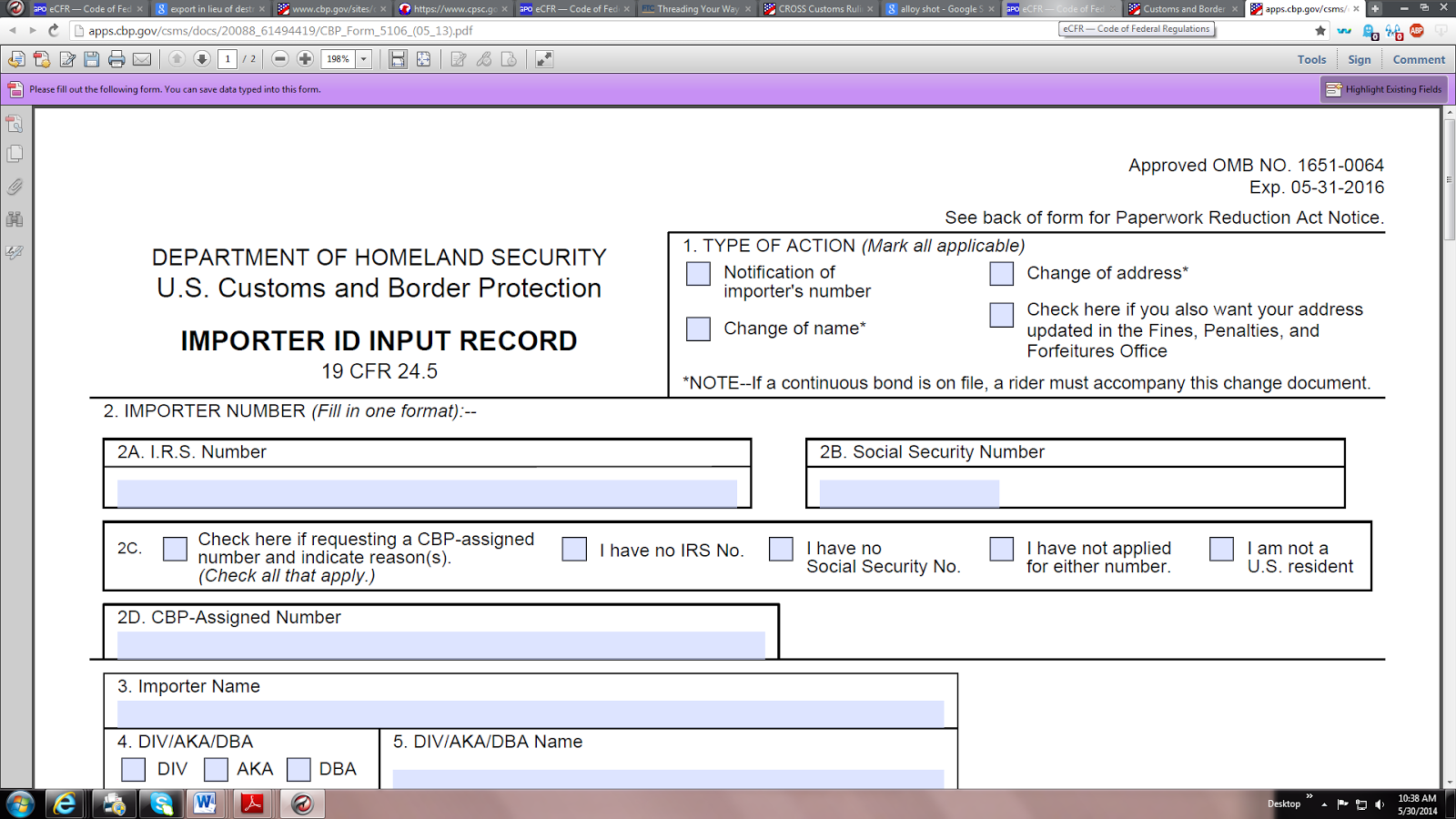
Effective July 1, 2014, the new versions of both the Customs Bond form (Form 301) and the Importer ID Input Record form (Form 5106) will be mandatory and any other version will not be accepted.


Links to these can be found here:

CUSTOMS BOND FORM (CF 301)

IMPORTER ID INPUT RECORD (CF 5106)

Any questions regarding either of these can be directed to Tom Scott, Office of Administration, at (317) 614-4502.

Any other questions or comments can be posted below or emailed to me at clark.deanna@gmail.com.


Keep up with me at www.fashioncompliance.com or:
On Twitter @fashcompliance

Monday, May 12, 2014

Free Importing Event This Thursday at 2 PM in NYC (34th St. and Madison Ave.)


You're invited to join my partner William Shayne, Esq. and I for a presentation on how to grow a successful import business at this World Trade Week NYC event this Thursday at the Science, Industry and Business Library.  Sponsored by the NY Chapter of the Organization of Women in International Trade together with #WTWNYC.  For more on this event, click here.

AND...For anyone that may be curious about that map behind us, it's a map from (we're guessing) the 1960s of the "U.S. Customs Service."

Questions/comments?  Post below or email me at clark.deanna@gmail.com.

Keep up with me:

www.facebook.com/fashioncompliance
www.fashioncompliance.com

Or follow me on Twitter @fashcompliance

Thursday, March 27, 2014

How Many Times Do I Have to Pay Duties?


The first time you import merchandise into the U.S., you would expect to pay customs duties, and under the Harmonized Tariff Schedule of the U.S. (HTSUS), unless the goods are exempted from such payment, that money will have to be paid.


But what about if the merchandise had

a. Already been imported,
b. Duties Paid,
c. Subsequently Exported, and
d. Now being reimported again?
 Is paying again required?
Well, depending on the circumstances, there can be ways of either recouping some of the initial duty payment, or qualifying for an exception to avoid paying the duty such as the exemption where articles exported from the U.S. are

1. Returned within 45 days of such exportation,
2. Were “undeliverable”, and
3. Which had not left the custody of the carrier or foreign customs service.

As a general rule however, 19 CFR 141.2 of the Customs regulations provides that dutiable merchandise imported and afterwards exported, even though the duty had been paid on the first importation, is liable for duty payment on every subsequent importation into the Customs territory of the US (unless exempt by law).

This rule does not however, apply to imports of:

(a) Personal and household effects taken abroad by a resident of the United States and brought back on his return to this country (see §148.31);

(b) Professional books, implements, instruments, and tools of trade, occupation, or employment taken abroad by an individual and brought back on his return to this country (see §148.53);

(c) Automobiles and other vehicles taken abroad for noncommercial use (see §148.32);

(d) Metal boxes, casks, barrels, carboys, bags, quicksilver flasks or bottles, metal drums, or other substantial outer containers exported from the United States empty and returned as usual containers or coverings of merchandise, or exported filled with products of the United States and returned empty or as the usual containers or coverings of merchandise (see §10.7(b), (c), (d), and (e));

(e) Articles exported from the United States for repairs or alterations, which may be returned upon the payment of duty on the value of repairs or alterations at the rate or rates which would otherwise apply to the articles in their repaired or altered conditions (see §10.8);

(f) Articles exported for exhibition under certain conditions (see §§10.66 and 10.67);

(g) Domestic animals taken abroad for temporary pasturage purposes and returned within 8 months (see §10.74);

(h) Articles exported under lease to a foreign manufacturer (see §10.108); or

(i) Any other reimported articles for which free entry is specifically provided.


Questions or comments?  Post below or email me at clark.deanna@gmail.com

Keep up with me at www.fashioncompliance.com or:


On Twitter @fashcompliance


Monday, September 23, 2013

Do You Make Men’s or Boy’s Suits of Imported Worsted Wool?

Submit Your Application by 5 pm on Oct. 15, 2013
 to Obtain a Tariff Rate Quota!
 
 
A “Tariff Rate Quota” (TRQ) is a temporary reduction on import duties, and in this particular case, it would mean a duty savings of 25%, or $25 on every $100, imported through Dec. 31, 2014.
Title V of the Trade and Development Act of 2000, which created this TRQ, requires that they be allocated to persons who
1) Cut and sew men’s and boy’s worsted wool suits, suit-type jackets and trousers in the United States, and/or
2) Weave worsted wool fabrics with an average fiber diameter of either 18.5 microns or less, OR that which is greater than 18.5 microns, for making men’s and boy’s suits.
Right now, applications to obtain this reduction are being accepted from “persons,” i.e., firms, corporations, or other legal entities, who either fall under either of the two above categories.
In order to be eligible for this TRQ, an application must be submitted on the form provided at http://otexa.ita.doc.gov/wooltrq/wool_app.htm
and be submitted by 5 pm on October 15, 2013 to the
Office of Textiles and Apparel, Room 30003
U.S. Dept. of Commerce
1401 Constitution Ave. NW
Washington, DC  20230
If you have any problems with the link above, you may also call (202) 482-3400.
Questions/comments?  Post below or email me at clark.deanna@gmail.com
Keep up with me:

On Twitter @fashcompliance 
https://twitter.com/fashcompliance

On Facebook 
http://on.fb.me/17Pocfj

On YouTube 
http://bit.ly/12a9lau


Tuesday, August 13, 2013

Corporate Officer of Men’s Suit Importer Avoids Joint Payment of $2,392,307 in U.S. Customs Penalties

On July 30, 2013, in Slip. Op. 11-527, U.S. v. Trek Leather, Inc. and Harish Shadadpuri, the Court of Appeals for the Federal Circuit (CAFC) reversed a U.S. Court of International Trade decision to impose penalties on the corporate officer of an “Importer of Record.”


“Trek Leather” (Trek), whose President and sole shareholder is Mr. Shadadpuri, was the Importer of Record for seventy-two (72) entries of men’s suits.  Mr. Shadadpuri is also a 40% shareholder to “Mercantile Electronics,” which was the consignee of these shipments.

Both Trek and Mercantile Electronics provided “assists” (in the form of fabric) to their suit manufacturers and failed to declare their value to US Customs.  Mr. Shadadpuri even admitted that he knew Trek (the Importer of Record) should have included the value of fabric assists in its duties but did not bother to do so.

 US Customs therefore brought a lawsuit claiming that under 19 USC §1592, both Trek and Mr. Shadadpuri, in his personal capacity, were liable for a penalty of $2,393,307 for fraudulently, knowingly, and intentionally understating the dutiable value of the imported men’s suits. 

Since Trek, a corporation, was the Importer of Record, Mr. Shadadpuri argued he could only be personally liable if the government established that he had pierced Trek’s “corporate veil” or established that he had either committed fraud, or aided and abetted Trek’s fraud, making him liable under 19 USC §1592.

 As Trek had conceded during the course of the litigation however, that its activity rose to a level of gross negligence, the government abandoned its fraud claim against Trek and instead proceeded alternatively on a claim of gross negligence.
 
Mr. Shadadpuri in his defense, argued that corporate officers of an Importer of Record are not directly liable for penalties under 19 USC §1592 – and the court agreed. 

 The CAFC’s 1999 decision in United States v. Hitachi America, Ltd., 172 F.3d 1319 (Fed. Cir. 1999), held that because one cannot “aid and abet” negligent conduct, Mr. Shadadpuri could not be liable for Trek’s admitted negligence unless the government could prove he was acting as Trek’s alter ego rather than as an officer of the corporation acting in his capacity as such.
 
The CAFC, agreeing with Mr. Shadadpuri, stated that under the basic principles of corporate law, Mr. Shadadpuri could not be personally charged with a claim of negligence for the actions he took on behalf of the corporation.

In CAFC’s own words:
 
“[T]he government [US Customs] has asked us to adopt a broad legal principle that would expose all corporate officers and shareholders to personal liability for negligent acts they undertake on behalf of their corporation.  Absent an explicit statutory basis for doing so, we decline to believe Congress intended to supplant the common law so completely…”

 To read the full decision, click here.
 
Questions/comments?  Post below or email me at clark.deanna@gmail.com
 
 
Keep up with me:
On Twitter @fashcompliance  https://twitter.com/fashcompliance
 

Saturday, June 1, 2013

Obtaining Export Declarations Under the AGOA Agreement

The US has preferential trade agreements with many other countries to promote and increase trade with those nations.

One of these is the “African Growth and Opportunity Act,” otherwise known as the AGOA agreement.

Doreen Mashika Print Clutch Bags - Zanzibar


As it pertains to textiles, its purpose is (in part) to provide for the entry of specific textile and apparel articles free of duty and free of any quantitative limits from the participating countries of sub-Saharan Africa.

For more information about the AGOA, check out these articles:


AGOA Renewal Recommendations Sought by USTR

 For preferential treatment under AGOA, the exporter is required to prepare a certificate of origin and provide it to the importer.  This certificate is something that the importer must request from the exporter to have and keep as part of its record keeping.  The certificate of origin includes information such as

(1)    The contact information for the importer, exporter and producer;

(2)    The basis for which preferential treatment is claimed; and

(3)    A description of the imported merchandise.

Importers are required to have the certificate in their possession at the time of the claim, and to provide it to Customs and Border Protection (CBP) upon request.

Questions/comments?  Post below or email me at clark.deanna@gmail.com
Keep up with me!

On Facebook at https://www.facebook.com/FashionCompliance 

On YouTube at http://www.youtube.com/user/fashioncompliance 

On Tumblr: http://fashioncompliance.tumblr.com

On Twitter @fashcompliance https://twitter.com/fashcompliance 

Sunday, December 2, 2012

Rising to “Official” Importer Status – Now What?


From essential oils to women’s jewelry, I’ve spoken with many small business owners whose enterprises are growing, so much so that the time has come from merely carrying back foreign articles for sale in their suitcases to actually becoming a commercial importer.

So who do you share the news with?  Well, with any good news you may want to share it with your loved ones, however you actually need to share it with US Customs and that is achieved through the submission of an "Importer ID Record," which is Customs Form 5106 (CF 5106) and may be found here.

Being an “official” first time importer, you would use this form to identify yourself to US Customs as such.  The form is also used if you are using an Importer Number for the first time, or if you have not engaged in any customs business within the past year.

The CF 5106 can also be used if there is already an importer number on file but there is a change in the name or address currently on file.

Importantly, this form has an extra box on the top of the first page to check if you also want your address updated at US Customs Fines, Penalties and Forfeitures Office.  I can’t tell you why it’s not automatically updated with that office, but I can tell you that a failure to do so via this form can leave an importer “on the hook” for the payment of a penalty for which no response had been made for mitigation or remission (i.e., “cancellation,” in everyday language) purposes.

In other words, saying that you never received a copy of the notice will not serve as a valid excuse for non-responsiveness if this form was not properly filed.  

One final note of importance is that where an importer has a continuous bond on file with US Customs, a rider must accompany the CF 5106 as well.  For more information on an importer’s bond requirements, see my article dated Sept. 16, 2009 here.

 Questions/comments?  Post below, email me at clark.deanna@gmail.com, or tweet/follow me on Twitter @fashcompliance

Tuesday, November 20, 2012

Eco-Friendly & Trade Agreement Beneficiary Gifts


With the holidays upon us, there is no shortage of vendors here in New York City offering gifts and stocking stuffers for sale. 

As I try to buy gifts made using either an eco-friendly production method or one which derives from a sustainable production environment – in terms of the workers involved – I was pleased to learn of Nakate Project’s high fashion necklaces and bracelets from Uganda that not only meet both of these standards but are also a gorgeous gift that I would be happy to give to any of my friends.
 
NOTE: As these goods come from the African continent, duty free treatment for these and thousands of other products is available under the GSP and AGOA programs.  Just another good reason to source from Africa!

Having been examining quite a bit of jewelry and accessories at my office lately, I wondered about the tariff classification of Nakate’s paper beaded necklace, an image of which can be found here. 

As this jewelry is not made of, nor contains, silver, gold or platinum, it would not be considered jewelry of a precious metal.   It likewise has no gemstones or semi-precious stones.  It further is not made of any base metal.

It therefore does not fall into these categories for classification purposes.  Rather, it falls into the classification for “Imitation Jewelry.”

Interestingly, jewelry of this kind is classified based upon a cost per quantity measurement.  (As an aside, if anyone reading this has any insight into the historical reason for this, it would be great if you could share it with the rest of us readers!)

The tariff specifically provides that if the jewelry is

… valued not over 20 cents per dozen pieces or parts, then classification will be 7117.90.5500 (HTSUS 2012) which provides for “Imitation jewelry: Other: Other: Valued not over 20 cents per dozen pieces or parts: Other.”  The rate of duty will be 7.2% ad valorem.

 OR

… valued over 20 cents per dozen pieces or parts, then classification will be 7117.90.9000 (HTSUS 2012) which provides for “Imitation jewelry: Other: Other: Valued over 20 cents per dozen pieces or parts: Other: Other.”  The rate of duty will be 11% ad valorem.

 Now I don’t know about you, but these types of figures beg the question…what type of jewelry (nevermind the parts) is valued at less than 20 cents (USD) per dozen pieces?  Or in other words, what type of jewelry (not including children’s or of plastic) is only 1.67 (i.e., $0.0167) cents/piece?  Umm…and what is the quality like?

 Questions/comments?  Post below or email me at clark.deanna@gmail.com


Friday, October 12, 2012

New US Customs “Centers for Excellence and Expertise” (CEE)


I attended a US Customs webinar yesterday that explained how the agency is in the process of setting up new “Centers for Excellence and Expertise” (CEE).  These centers – which are virtual – are intended to bring existing expertise together in order to facilitate trade on the part of US Customs and to align its procedures with modern business practices.

Of greater significance however, is that US Customs intends to assign each importer with an account at a CEE to route entry summaries through and to use these virtual environments to move non-revenue collection activity to a CEE for handling protests, the review of prior disclosures and other activities.  Revenue collection however, will continue to be done at the port of entry.

The creation of CEEs are part of US Customs’ “trade transformation efforts,” which also includes an overhaul of 19 CFR Part 111, which are the customs brokers regulations.

CEEs are meant to serve as an information resource for the importing community, be it a large or small importer or broker, US Customs itself, or another government agency.  Customs stated that it has created CEEs by industry in order to focus on industry-specific issues so it can better meet the challenges for that industry.  Unfortunately, with such few and broad categories (listed below) in relation to the thousands of types of imported merchandise, it is questionable as to how well this intention will be met.

The goals of the CEE are:

1)      To facilitate legitimate trade through effective risk management and to “segment” risk so as to get the “good actors” out of the way in order to focus on the riskier participants,
2)      To increase industry-based knowledge within Customs and to better understand the unique practices within an industry, and
3)      To enhance enforcement efforts and to partner with industry stakeholders in order to understand and address industry risks.

As it stands, nine (9) industry groups were identified by Customs for which nine (9) CEEs are to be created.  Four (4) of them have already opened, listed as the first four (4) in the list below, and importers are already welcome to solicit participation in one of them.
Open CEEs:

1)      Electronics (Long Beach, CA)
2)      Pharmaceutical Health and Chemicals (New York)
3)      Automotive and Aerospace (Detroit, MI)
4)      Petroleum, Natural Gas and Minerals (Houston, TX)

Unopened Centers:
5)      Apparel, Footwear and Textiles
6)      Base Metal and Machinery
7)      Consumer Products and Mass Merchandising
8)      Industrial and Manufacturing Materials
9)      Agriculture and Prepared Products

For more information, you can check out this Federal Register Notice at 77 FR 52048 dated August 28, 2012, access a .pdf version here), or email US Customs directly at cee@cbp.dhs.gov.

Questions/comments?  Post below or email me at clark.deanna@gmail.com

Wednesday, September 5, 2012

An Importer’s Requirement to Retain Records


Sure, you know that it is important to keep business records, but did you know that it is against the law not to?

Importers are mandated under the law, and specifically under 19 U.S.C. 1509(a)(1)(A) and 19 CFR Part 163, to keep records for 5 years from the date of entry, and to make them readily available in the event Customs requests to review a transaction.

A primary issue as it relates to Customs and Recordkeeping is the ability to locate those records tracing backwards from the Customs Transaction.

 Luckily, most of the records that are required to be kept for Customs purposes are the same as those normally kept for business and tax purposes. 

Those that need to be kept include the

-        - Commercial Invoice
-        - Packing List
-        - Bill of Lading or Waybill (e.g., Air, Rail)
-        - Entry Summary

      As good practice, proofs of payment not only for the merchandise itself, but for the freight and customs broker fees, along with their invoices, together with any other declarations filed, such as a US Dept. of Fish and Wildlife Declaration form, a Statement of Non-Reimbursement form for an anti-dumping duty, or an Interim Footwear Invoice.

Every effort should be made to maintain records on-site going back at least 1 year, or such longer period as storage will permit.  In addition, when records are sent off-site for storage, a log should be kept identifying the records, where they are archived, and how to retrieve them.

Remember, the proper preparation and maintenance of complete and accurate transaction documentation is essential to both good commercial operations as well as Customs compliance.

Questions/comments?  Post below or email me at clark.deanna@gmail.com

Wednesday, January 11, 2012

(The Many) Invoice Declarations Required for Imported Footwear

Whereas most articles imported into the U.S. are not required to have declared on a commercial invoice (or attached to an invoice) many details beyond the quantity, price, and a limited number of other factors, certain categories of imports, such as bed linens and wearing apparel, require significantly more.

Footwear is a category that requires many more details as well, so much so, that often times there is an additional “boilerplate” form filled out with the information that is commonly known as an “Interim Footwear Invoice.”

---As an aside, an experienced importer of footwear will know about this rule. For new importers, be sure to do your “homework” on import requirements as the lack of this information can raise a red flag to US Customs as to both an importer’s reasonable care compliance obligations as well as to the truthfulness of the imports as declared on the entry and commercial invoice.

To give you an idea of what is required, as described in 19 CFR §141.89 and reprinted below, additional declarations for Footwear, classifiable in headings 6401 through 6405 of the HTSUS, include identifying the:

1. Manufacturer's style number.
2. Importer's style and/or stock number.
3. Percent by area of external surface area of upper (excluding reinforcements and accessories) which is:
Leather, composition leather, rubber and/or plastics, textile materials, or “other,” and requires specifying the percentage of each type of material.
4. Percent by area of the external surface area of the outersole (excluding reinforcements and accessories) that is:
Leather, composition leather, rubber and/or plastics, textile materials, or “other,” and requires specifying the percentage of each type of material.

Other footwear requirements under this same provision (19 CFR §141.89) may include answering questions “A” to “Z” (yes, all of them!) as follows:

A. The percent of external surface area of upper (including leather reinforcements and accessories)
Which is leather _____%
B. The percent by area of external surface area of upper ( including all reinforcements and accessories)
Which is rubber and/or plastics _____%
C. Percent by weight of rubber and/or plastics is _____%
D. Percent by weight of textile materials plus rubber and/or plastics is _____%
E. Is it waterproof?
F. Does it have a protective metal toe cap?
G. Will it cover the wearer's ankle bone?
H. Will it cover the wearer's knee cap?
I. [Reserved.] (i.e., unknown to the public...)
J. Is it designed to protect against water, oil, grease, or chemicals, or cold or inclement weather?
K. Is it a slip-on?
L. Is it a downhill or cross-country skiboot?
M. Is it serious sports footwear other than skiboots? (Chapter 64 subheading note defines sports footwear.)
N. Is it a tennis, basketball, gym, or training shoe or the like?
O. Is it made on a base or platform of wood?
P. Does it have open toes or open heels?
Q. Is it made by the (lipped insole) welt construction?
R. Is it made by the turned construction?
S. Is it worn exclusively by men, boys or youths?
T. Is it made by an exclusively adhesive construction?
U. Are the fibers of the upper, by weight, predominately vegetable fibers?
V. Is it disposable, i.e. , intended for one-time use?
W. Is it a “Zori”?
X. Is the leather in the upper pigskin?
Y. Are the sole and upper made of woolfelt?
Z. Is there a line of demarcation between the outer sole and upper?

The information requested above may be furnished on a US Customs form, CF 5523, or other appropriate format by the exporter, manufacturer or shipper.

Where footwear falls into a particular tariff classification, namely one in HTSUS subheading 6401.99.80, 6402.19.10, 6402.30.30, 6402.91.40, 6402.99.15, 6402.99.30, 6406.11.40, 6404.11.60, 6404.19.35, 6404.19.40, or 6404.19.60, the following information must also be provided:

1) Does the shoe have a foxing or foxing-like band? If so, state its materials(s).

2) Does the sole overlap the upper other than just at the front of the toe and/or at the back of the heel?

In order to help clarify the meaning of some of the terms in "A" to "Z" above, the regulations provide definitions as follows:

a. In an exclusively adhesive construction, all of the piece(s) of the bottom would separate from the upper or from each other if all adhesives, cements, and glues were dissolved. It includes shoes in which the pieces of the upper are stitched to each other, but not to any part of the bottom. Examples include:

1. Vulcanized construction footwear;
2. Simultaneous molded construction footwear;
3. Molded footwear in which the upper and the bottom are one piece of molded rubber or plastic, and
4. Footwear in which staples, rivets, stitching, or any of the methods above are either primary or just extra or auxiliary, even though adhesive is a major part of the reason the bottom will not separate from the upper.

b. Composition leather is made by binding together leather fibers or small pieces of natural leather. It does not include imitation leathers not based on natural leather.

c. Leather is the tanned skin of any animal from which the fur or hair has been removed. Tanned skins coated or laminated with rubber and/or plastics are “leather” only if the leather gives the material its essential character.

d. A line of demarcation exists if one can indicate where the sole ends and the upper begins. For example, knit booties do not normally have a line of demarcation.

e. Men's, boys' and youths' sizes cover footwear of American youths sizes 111/2and larger for males, and do not include footwear commonly worn by both sexes. If more than 4% of the shoes sold in a given size will be worn by females, that size is “commonly worn by both sexes.”

f. Footwear is designed to protect against water, oil or cold or inclement weather only if it is substantially more of a protection against those items than the usual shoes of that type. For example, leather oxfords will clearly keep one's feet warmer and drier than going barefoot, but they are not a protection in this sense. On the other hand the snow-jobber is the protective version of the nonprotective jogging shoe.

g. Rubber and/or plastics includes any textile material visibly coated (or covered) externally with one or both of those materials.

h. Slip-on includes:

1. A boot which must be pulled on.
2. Footwear with elastic cores which must be stretched to get it on, but not bootwear having a separate piece of elasticized fabric which forms a full circle around the foot or ankle.

i. Sports footwear includes only:
(1) Footwear which is designed for a sporting activity and has, or has provision for, the attachment of spikes, sprigs, cleats, stops, clips, bars or the like;
(2) Skating boots (without skates attached), ski boots and cross-country ski footwear, wrestling boots, boxing boots and cycling shoes.

j. Tennis shoes, basketball shoes, gym shoes, training shoes and the like covers athletic footwear other than sports footwear, whether or not principally used for such athletic games or purposes.

k. Textile materials are made from cotton, other vegetable fibers, wool, hair, silk or man-made fibers. Note: Cork, wood cardboard and leather are not textile materials.

l. In turned construction, the upper is stitched to the leather sole wrong side out and the shoe is then turned right side out.

m. Vegetable fibers include cotton, flax and ramie, but do not include either rayon or plaiting materials such as rattan or wood strips.

n. Waterproof footwear includes footwear designed to protect against penetration by water or other liquids, whether or not such footwear is primarily designed for such purposes.

o. Welt footwear means footwear constructed with a welt, which extends around the edge of the outer sole, and in which the welt and shoe upper are sewed to a lip on the surface of the insole, and the outer sole is sewed or cemented to the welt.

p. A zori has an upper consisting only of straps or thongs of molded rubber or plastic. This upper is assembled to a foamed rubber or plastic sole by means of plugs.

For more information about importing Footwear, US Customs has an “Informed Compliance Publication” which may be accessed here.

To see a sample of an “Interim Footwear Invoice,” click here.


Questions/comments? Post below or email me at clark.deanna@gmail.com


Tuesday, January 3, 2012

CPSC Signals That Flammability and Lead Risks Related to Children’s Sleepwear a Priority Issue for 2012

In a letter to importers, manufacturers, retailers and distributors of children’s sleepwear and loungewear late last year, the Consumer Products Safety Commission (CPSC) sent a reminder of its enforcement policy as it relates to risks of burn injuries and chemical contamination.

Children’s sleepwear standards were developed to prevent children’s sleepwear from igniting due to exposure to ignition sources, such as candles, ranges, stoves, matches/lighters, space heaters and fireplaces. Most of the ignition incidents were found to occur while children were wearing sleepwear or sleep-related items during the evening before bedtime or in the morning around breakfast time.

In addition to burn prevention, contamination by way of lead exposure was also signaled as a priority issue as this letter included a summary of the Consumer Product Safety Improvement Act of 2008 (CPSIA) requirements which include the usage of tracking labels, a certificate of compliance and testing requirements for phthalates, lead content and lead in surface coatings on snaps, zipper pulls and elsewhere on the product.

CPSC is charged with protecting the public from unreasonable risks of injury or death associated with the use of the thousands of consumer products under the agency's jurisdiction.

Included in its jurisdiction is the oversight and enforcement of the Flammable Fabrics Act, which includes protecting the public from the hazards of flammable fabrics, interior furnishings and wearing apparel, including children’s sleepwear.

“Children’s sleepwear” includes any product of wearing apparel (in sizes 0–14), such as nightgowns, pajamas, or similar or related items, such as robes, intended to be worn primarily for sleeping or activities related to sleeping. Exemptions to this definition include: (1) diapers and underwear; (2) “infant garments,” sized for a child nine months of age or younger; and (3) “tight-fitting garments” that meet specific maximum dimensions.

Children’s sleepwear includes “loungewear” as a type of children’s sleepwear which was introduced to the children’s market in the 1990s. CPSC considers children’s “loungewear,” or other similar garments marketed as comfort wear, as garments worn primarily for sleep-related activities. Therefore, “loungewear” must comply with the children’s sleepwear standards as well.

For more information on some of the related regulations, click here.

Questions/comments? Post below or email me at clark.deanna@gmail.com


Monday, October 31, 2011

US Customs Perspective on Ambiguities in CAFC Decisions

The CAFC is the appeals court for cases that are heard at the U.S.C.I.T. for which appeal is sought by a party that is unhappy with the lower court’s decision. The U.S.C.I.T. hears cases that both relate to US Customs and Border Protection issues, such as those regarding the classification or valuation of merchandise, in addition to hearing what are known in the industry as “trade” cases which deal with anti-dumping duties (ADD) and/or countervailing duty (CVD) issues, whose duties and the rules are governed by the U.S. Dept. of Commerce (DOC).

Last week I had the pleasure of going to the Court of Appeals for the Federal Circuit (CAFC) in Washington D.C. to attend a seminar that dealt, in part, with court decisions and ambiguities therein. Among the speakers was Sandra Bell, Executive Director for the Office of Regulations and Rulings at U.S. Customs, who shared a few thoughts from her agency’s perspective.

US Customs primary interest in court decisions is their impact on the agency to have a clear mandate follow after the decision is made. That is, in her own words, she wanted to see a “bright line rule” so that US Customs could have clear guidance for setting regulatory policy that would be in accordance with court decisions.

Ms. Bell spoke about 2 cases in which US Customs “learned” a bright line rule. In the first case, the court had to consider whether or not US Customs had erred by not accepting certain information from an importer regarding ADD which had not been provided at the time of entry, but which had been later provided pre-liquidation.

When it comes to ADD, US Customs is merely supposed to follow instructions set by the DOC regarding the treatment of imported goods subject to an ADD. US Customs does not have the authority to make independent decisions or rules regarding the cargo when it comes to the application of ADD rules on imports.

Despite this, US Customs nonetheless denied the acceptance of the importer’s post-entry submission of information with respect to ADD, deeming it to be untimely as it had not been filed at the time of entry, and ultimately denied the Protest made by the importer (who claimed it had filed all of the requisite information) despite it having been timely filed.

The outcome of this case - or in other words, the Bright Line Rule - was that when applying DOC instructions, US Customs is required to consider additional information properly provided in a Protest and by not doing so, it’s actions had been wrong.

Another example of a case that had a “bright line” was CBB Group, Inc. v. United States, Slip Op. 11-75.

This case dealt with a detention by US Customs of plush toys with a protected trademark on the toys. Rather than seizing the goods, US Customs merely detained them without making a decision on the status of the goods. It detained them for so long that they were ultimately considered a “deemed exclusion.”

CBB Group filed a Protest which was denied by US Customs and the very next day CBB Group went to the U.S.C.I.T. and filed a Summons to begin the process of judicial review of the action taken by US Customs. Oddly enough, US Customs decided at virtually the same time, but not before the Summons had been filed, to seize the goods.

The question presented to the court was thus a jurisdictional one: Whether or not Customs was still able to control the cargo now that a court case had been commenced, or if instead, that jurisdiction was now with the court.

The outcome of this case was that once jurisdiction had already been attached by the U.S.C.I.T., it was no longer within the purview of US Customs to take further action with respect to the cargo.

Both of these cases reflected outcomes that were unfavorable to US Customs however, both provided guidance with respect to how to treat cargo under specific circumstances, and for this they were instructive and of value to the agency according to Ms. Bell.

Whether the case was favorable to the agency or not, what mattered was that there was clear guidance with respect to agency action that came out of the decision.

Contrasting these decisions to a different one, another speaker made reference to the Le Mans Corporation v. US, 2010-1295 case, in which sportswear for motorcross activity had not been considered as being properly classified under Chapter 95 as articles of sports equipment but were instead classified under Chapter 61 and 62 as apparel.

In this case, a long-established designation for what had been considered sportswear was prima facie challenged (however, upon further discussion it was pointed out by an audience member that a distinction had been made with respect to the padding within the garment itself, causing it to be categorically ineligible - something I am sure other members of the bar could have argued about in disagreement.)

As many other sports equipment cases had been decided under this long-established designation, the court’s decision to not treat these articles in a similar fashion was considered by many to have created an ambiguity within the classification of such products.

Ambiguities may make it harder to know how to classify a particular item, and some would argue that it does. On the flip side of this however, it is the flexible nature of an ambiguous decision itself that can provide for a broader application of a certain set of rules across a wider variety of imports.

Questions/comments? Post below or email me at clark.deanna@gmail.com

Tuesday, March 15, 2011

New Requirements for Wine and Other Alcohol Importers and Wholesalers

I was doing some research on a wine region I particularly like called Rias Baixas which derives from both Spanish and Portuguese wine regions.

While red wine had traditionally been my preferred type of wine, the juicy white wines from this region have become my all time favorite. In so doing this research, I came across the following new regulation.

A new requirement for wine and other alcohol importers and wholesalers went into effect last month regarding the inclusion of certain corporate records when submitting an application to the government to operate as one of these entities.

Irrespective of the type of legal entity formed, i.e., corporation, partnership, etc., the submission of the following records is now mandatory:

1. Source of Funds Documentation
2. Trade Name Registration (if required by State or local government)

Also obligatory is the submission of additional organizational records, the requirements for which, vary depending on the entity’s type as follows:

Corporations:

* Articles of Incorporation and Certificate of Incorporation/Formation
* By-Laws
* Certificate to Operate in a Foreign State (if organized in a different state)

Partnerships:

* Partnership Agreement

Limited Liability Corporations (LLCs)

* Operating Agreement
* Articles of Incorporation and Certificate of Incorporation/Formation

While these rules went into effect on February 14, 2011, the federal agency, the Alcohol and Tobacco Tax and Trade Bureau (TTB) who enforces these rules, has granted a grace period through April 15, 2011 in order to allow businesses an opportunity to adapt to the new requirements.

For those who have submitted applications without the above documentation, TTB will grant the submission of such records through April 15, 2011. After this time, applications without these documents will be considered "incomplete."

To give a little background on TTB, it is the federal agency responsible for the labeling, advertising, and marketing of alcoholic beverages. TTB is also mandated to enforce the laws and write the regulations on the collection of alcohol, tobacco, firearms and ammunition excise taxes.

For more information on TTB regulatory compliance specific to wine click here and for those specific to importing or exporting wine click here.

For some nice images and to learn more about visiting this area, click here. (This is not an endorsement, though it is a nice website!) - Have I mentioned the Iberian peninsula is my favorite part of the world to spend time in?

Questions/comments? Post below or email me at clark.deanna@gmail.com

Thursday, January 20, 2011

Welcome to a New Year of Customs Audits!

While just a few weeks into the new year, I can’t help but notice that US Customs is off to the races with its auditing programs, one of which I will write about here known as a “Focused Assessment.”

The Focused Assessment program is a systematic risk-based approach to auditing in which the auditing team evaluates a company’s Customs and Border Protection (CBP) related internal controls to determine the likelihood of non-compliance and assess “risk.”

As shown by the definition above, and probably presumed by most importers when it receives the phone call indicating that an audit will be occurring in the (near) future, when US Customs comes in to do one, it already suspects some wrong doing on the part of the importer.

This does not mean, however, that an importer was knowingly or intentionally engaged in “risky behavior,” which can take many possible forms, such as classifying merchandise with an erroneous tariff number, or failing to add into the dutiable value of a product an item supplied by the importer (to its manufacturer) for incorporation into the merchandise ultimately imported, which is commonly referred to as an “assist.”

An example of this would be a women's sleepwear importer supplying bows to its vendor for attachment to robes or night gowns that it imports. Under US Customs regulations pertaining to “valuation” (which in everyday language, is the methodology for determining the dutiable value of imported merchandise), both the cost of the article supplied by the importer AND the cost of the freight to ship it to the vendor must be added to the invoice value of the imported merchandise. This of course, can be a tricky thing to calculate but alas, it is not the subject of this blog post so I will continue with my discussion on focused assessments. (If you have a valuation question, feel free to email me).

There are three (3) distinct phases to a focused assessment.

1. Pre-Assessment Survey: An evaluation of a company’s internal controls over US Customs related operations
2. Assessment Compliance Testing: “Transaction testing” used to measure compliance and/or to determine a loss of revenue (i.e., an amount of duties that the government believes should have been paid on certain importations), and
3. Follow-up Review: Verification of a company’s corrected action

The primary areas US Customs focuses on during an assessment are valuation, classification, anti-dumping/countervailing duties, transshipment and intellectual property rights. Secondary areas for assessment include, foreign trade zone activity, special trade programs, such as NAFTA (North American Free Trade Agreement) and special duty provisions, which are those found in Chapter 98 of the HTSUS (Harmonized Tariff Schedule of the United States).

Key features of a focused assessment include:

a) The identification of imports that represent the greatest risk of trade noncompliance
b) The evaluation of the adequacy of a company’s internal control system, and
c) Methods for improving future compliance by identifying risk and reducing it.

But how does US Customs go about evaluating the adequacy of a company’s internal control system? It does so by looking at the following five (5) specific components of a company.

The first is what US Customs refers to in its focused assessment literature as a company’s “Control Environment,” as this apparently “sets the tone of an organization, influencing the control consciousness of its people.” I must admit, even though US Customs attempts to keep importers informed, language such as this “control environment” definition leave little to be understood.

What it is really getting at however, is the question of “What procedures are in place to maintain checks and balances within a company across company activities?” And, given that US Customs is making this inquiry, this question is focused on a company’s import activities.

The second is “Risk Assessment,” that is, Customs recognizes that multiple external and internal risks are faced by each company, and that these risks must be identified and analyzed. It therefore wants to see that a company has made this identification of potential risks across company activities.

The third is known as, “Control Activities,” which are the policies and procedures in place to ensure that management directives are implemented.

The fourth area US Customs is looking at is categorized as “Information and Communication” wherein the identification and summation of information that supports all other control components is communicated throughout a company’s personnel and those entities it works with (that have reason to be communicated to, with respect to “controls.”)

The fifth and final area, is that of “Monitoring,” which evaluates a company’s internal systems.

An evaluation of these five components occurs in the pre-Assessment Survey portion of the focused assessment. Depending on the results of this survey, determines where US Customs goes next with its auditing actions.

In my experience, these audits are time consuming, disruptive to regular business, and may leave an importer in a sleep deprived state. All the more reason to stay both informed and on top of US Customs compliance guidelines.

Questions/comments? Post below or email me at clark.deanna@gmail.com.

Tuesday, July 13, 2010

US Customs Report Shows Importing Community Doing a Good Job

US Customs recently published its 2010 mid-year fiscal report entitled, “Import Trade Trends.” Not surprisingly, after the IRS and Social Security Administration, money collected through US Customs is the third largest source of revenue for the US government.

What may be surprising however, is that only 29% of imported goods are dutiable! The remaining 71% are either duty-free or free under a preferential tariff program.

In case you think this sounds charitable on the part of the U.S., think again. Just as benefits to some foreign imports exist at our borders, the same goes for U.S. products entering those other countries. It is not so much that the U.S. wants to give another country a “hand” (though it may be framed that way in the media), but the idea behind preferential trade agreements is to help facilitate greater U.S. exports by causing more favorable conditions of our products in to foreign lands.

Of interest in the report is that starting last year, China – a country the U.S. does not have a preferential trade agreement with – surpassed Canada – a country the U.S. has NAFTA (North American Free Trade Agreement) with – as the top source of imports for America. China is further projected to maintain this lead into 2011.

So far, the first 6 months of the 2010 fiscal year has resulted in $15 billion in revenue for the federal government. Not only that, but a random sampling by US Customs showed that 98.6% of these 2010 imports were materially compliant with the regulations and trade laws of the U.S.

Not only is this rate higher than in recent years, but it demonstrates that importers, and those of us who help importers be compliant, are doing a pretty good job.

Priority trade issues include those involving:

-Textiles - Penalties

- Intellectual Property Rights

- Antidumping and Countervailing Duties

-Import Safety - Agriculture

-Revenue Collection

Lastly, in the spirit of increased partnering with the public, US Customs has a new online reporting system called “e-Allegations” to report suspected illegal import/export activity as well as the US Customs Freedom of Information Act (FOIA) Electronic Reading Room.

For importers specifically, the new phase of ACE was rolled out and is now capable of processing 98% of the entry summaries received by US Customs.

To read the full report, click here.

Questions/comments? Post below or email me at clark.deanna@gmail.com