Showing posts with label CPSC. Show all posts

Monday, April 13, 2015

Tips for the New Exporter Expanding in to the U.S. Market

This article was written for UK Trade and Investment to provide some tips to new UK exporters selling through the platform "Newegg" for delivery to your average American household.


Think being small means you don’t matter?  Think again!

All shipments arriving from outside of the United States pass through US Customs and the last thing you want to be is a company who is on their list of foreign suppliers to pay attention to.

You further don't want to be the supplier that creates a problem for your U.S. buyer as it could destroy your relationship with the buyer as well as harm your reputation and detract others from buying from you.
You therefore want to have your "ducks in order" with regards to legal compliance of the products you're selling into the US market, even if you're doing so in small quantities.
 Here are 5 tips to help you do that:

1) Recognize that the law applies to those who are selling and even offering to sell in the U.S.

·       That means that even if you have not sold anything, just by virtue of offering the merchandise for sale, it requires compliance with US laws.

·       Keep in mind that each shipment adds to your supplier profile with US Customs.  Though you may start out with “Newegg,” as your business expands your shipments to the U.S. will grow too and your sales here form a part of your export history recorded with U.S. Customs.

2) Understand that many of the products you want to sell may require testing and certification as to compliance with the U.S. law(s) over that category.  For example:
  • ·      The US Consumer Product Safety Commission has oversight of many of these laws and you can go to www.cpsc.gov to learn more about how their rules might apply to your products, including toys and other children’s products
  • ·      The US Food and Drug Administration has oversight of many food, health and beauty products, including cosmetics
  • ·      The US Federal Trade Commission has oversight of clothing and home fashions, as well as marketing claims which may be placed on packaging or temporary labels 

3) Remember that compliance with these laws is required prior to its importation into the U.S.
  • ·      While you may think of yourself as “just a seller,” if you’re selling to an individual, remember that they are relying on you to sell them a safe product that complies with U.S. law
  • ·      If you’re selling to a reseller, or are trying to sell to one, then they may request from you proof of your compliance with U.S. laws, so you’ll need to have your conformity certificates in order to provide them to those vendors relying on you. 

4) Product compliance aside, there are import protocols which must be complied with such as the proper marking and valuation of the product, as well as invoicing so that US customs can asses the appropriate amount of duties on that particular product.

5) Remember, even though a shipment which has a value not exceeding $200 can enter the U.S. free of duties and other taxes, the marking, valuation, invoicing and product compliance rules all still apply and again, all of these must be correctly done when you (the exporter) ship your product out for export.
  • ·       A watch for example, not only has multiple requirements in terms of marking different parts of it with its country of origin information, declaring a watch’s value is overly complicated and so both the physical stamping of the watch parts as well as the invoice need to be prepared in such a way that it meets US Customs regulatory compliance standards.

Questions/comments?  Post below or email Deanna at clark.deanna@gmail.com

Learn more at www.fashioncompliance.com or
Tweet us @fashcompliance on www.twitter.com or


Thursday, July 24, 2014

CPSC Proposes Amending GCC Rules


Importers:  Did you know that the Consumer Product Safety Commission (CPSC) has proposed to amend the existing rule on the General Certificate of Conformity (GCC)?


Amendments including the requirement for the electronic filing of GCCs for regulated imported consumer products with U.S. Customs and Border Protection (CBP) at the time of filing the CBP entry, or the time of filing the entry and entry summary, are just some of the proposed amendments. 
Not keen on this idea?  You are in luck! 
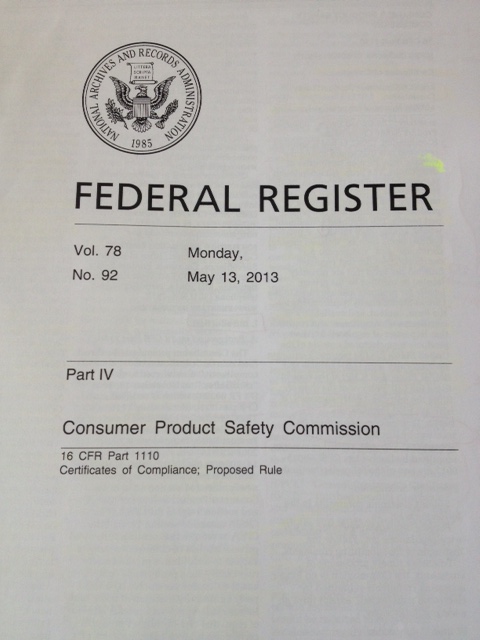
 The CPSC recently voted to hold a workshop and seek additional public comments on aspects of its proposed rule on Certificates of Compliance, which the Commission first published on May 13, 2013.

Interested parties are invited to participate in, or attend the workshop, and to submit written comments.

The workshop will be held from 9 a.m. to 4 p.m. on Thursday, September 18, 2014 in the CPSC Hearing Room, 4th Floor of the Bethesda Towers Building, 4330 East West Highway, Bethesda, MD 20814.

Registration is now open using the following link, where you can also read the  formal notice by CPSC:

Questions or comments? Post below or email me at clark.deanna@gmail.com

Keep up with me at www.fashioncompliance.com or:


On Twitter @fashcompliance

Friday, July 26, 2013

Retailers and Importers May be Subject to More CPSC Certificate Requirements?


Ever Heard of a “Finished Product Certificate?”   Or a “Component Part Certificate?”
 

These are but two (2) of a list of new definitions that the Consumer Product Safety Commission (CPSC) is proposing to implement, and with newly defined terms of course, come new requirements.

Certification by a private labeler for products manufactured in the US is one of the proposed new rules, as well as the requirement by an importer of regulated finished products manufactured outside of the US to file its mandatory certificate at the time of filing the entry (and entry summary, if filed together).
Last Weekend To Get Your Comments in to CPSC on Certificates of Compliance

It is your last weekend to prepare and submit your comments related to these proposed rules as written comments must be received by  Monday, July 29, 2013.

To read more about this and for the links on where to electronically submit your comments, check out the Federal Register notice announcing this proposed rule which may be found at 78 FR 28080 or by clicking here.

Questions/comments?  Post below or email me at clark.deanna@gmail.com
Join me:
On Facebook at https://www.facebook.com/FashionCompliance

On YouTube at http://www.youtube.com/user/fashioncompliance

On Tumblr: http://fashioncompliance.tumblr.com/

On Twitter @fashcompliance https://twitter.com/fashcompliance


Friday, March 30, 2012

Regulating Fashion

If you want to sell products in the largest economy in the world (namely, in the USA), you have got to play by its rules.

Whether it is related to protecting a US industry or the US consumer, there are multiple federal agencies that regulate products sold in the American market. The same goes for the European Union (EU), and an easy example of regulation for the sake of consumer protection is one with respect to restrictions on beef imports in the wake of “mad cow” disease some years ago.

In the context of fashion however, we are not interested in every federal agency but rather a limited number with certain exceptions. We would not, for example, typically need the US Food and Drug Administration (FDA) when importing an apparel article. If the “meat dress” worn by singer Lady Gaga were to be imported however, and therefore arriving in a refrigerated container (aka, a “reefer”) unlike most apparel imports which do not require temperature controlled transport, FDA compliance questions may arise.

This is because the FDA has a 24 hour rule with respect to the declaration of food imports – even though with its primary purpose being an article of apparel, the importer may attempt to classify it as such as opposed to raw meat.

While speaking with another professor at a fashion conference recently, I learned that risk recognition and assessment in the context of the fashion industry is not a subject closely looked at in tandem with importation. As this is an area of law I deal with frequently, I explained to him a number of risks and offered to go down to his school to do a seminar on this topic.

Risks not only arise with the more obvious Consumer Product Safety Commission (CPSC) flammability, lead and other rules, but can also come up in the context of labeling, for issues arising under the Federal Trade Commission’s (FTC) jurisdiction such as those involving the letters “USA” on a product not actually made in the USA.

There is also the US Fish and Wildlife that regulates other products under the fashion umbrella such as an importation of watches with a mother-of-pearl dial.

With US Customs serving as the watchdog at the border for compliance with all US federal agency rules, it is imperative for an importer to have done its regulatory due diligence in order to avoid fines and penalties by one or more of these agencies.

Questions/comments? Post below or email me at clark.deanna@gmail.com


Tuesday, January 3, 2012

CPSC Signals That Flammability and Lead Risks Related to Children’s Sleepwear a Priority Issue for 2012

In a letter to importers, manufacturers, retailers and distributors of children’s sleepwear and loungewear late last year, the Consumer Products Safety Commission (CPSC) sent a reminder of its enforcement policy as it relates to risks of burn injuries and chemical contamination.

Children’s sleepwear standards were developed to prevent children’s sleepwear from igniting due to exposure to ignition sources, such as candles, ranges, stoves, matches/lighters, space heaters and fireplaces. Most of the ignition incidents were found to occur while children were wearing sleepwear or sleep-related items during the evening before bedtime or in the morning around breakfast time.

In addition to burn prevention, contamination by way of lead exposure was also signaled as a priority issue as this letter included a summary of the Consumer Product Safety Improvement Act of 2008 (CPSIA) requirements which include the usage of tracking labels, a certificate of compliance and testing requirements for phthalates, lead content and lead in surface coatings on snaps, zipper pulls and elsewhere on the product.

CPSC is charged with protecting the public from unreasonable risks of injury or death associated with the use of the thousands of consumer products under the agency's jurisdiction.

Included in its jurisdiction is the oversight and enforcement of the Flammable Fabrics Act, which includes protecting the public from the hazards of flammable fabrics, interior furnishings and wearing apparel, including children’s sleepwear.

“Children’s sleepwear” includes any product of wearing apparel (in sizes 0–14), such as nightgowns, pajamas, or similar or related items, such as robes, intended to be worn primarily for sleeping or activities related to sleeping. Exemptions to this definition include: (1) diapers and underwear; (2) “infant garments,” sized for a child nine months of age or younger; and (3) “tight-fitting garments” that meet specific maximum dimensions.

Children’s sleepwear includes “loungewear” as a type of children’s sleepwear which was introduced to the children’s market in the 1990s. CPSC considers children’s “loungewear,” or other similar garments marketed as comfort wear, as garments worn primarily for sleep-related activities. Therefore, “loungewear” must comply with the children’s sleepwear standards as well.

For more information on some of the related regulations, click here.

Questions/comments? Post below or email me at clark.deanna@gmail.com


Monday, November 21, 2011

CPSC Compliance and Consumer Products Not Intended for Children

Importers and the government can often take radically opposite positions when it comes to what is considered a children’s product. Given the myriad of extra regulations surrounding goods for children, it is no wonder that so many importers try to steer clear of having what they consider to not be children's product, identified as such.

The difficulty arises however, when dealing with an article that could be considered attractive to a child. A 3-inch sized colorfully painted object, intended to be merely a decorative household item, could ultimately be considered a toy or children’s product by a government agency. The same holds for a decorative plush good that had not been intended for sale to children but could easily double as a children’s plush toy.

While some imports are an obvious decorative housewares product, such as a large wall plaque with a beer logo on it, with such attachments for hanging already affixed to it, and is therefore, clearly identifiable as not being intended for a child, others simply do not hold water when it comes to the government’s determination as to it not being a children’s article.

With regards to compliance, any imported article with paint or some other surface coating would be subject to Consumer Product Safety Commission’s (CPSC) rules and require lead paint testing if it is considered a “children’s product” by the government.

In addition to the surface coating issue, when children’s products are involved, there are also lead testing (separate from the lead paint issue), tracking label and other possible rules, such as that regarding small parts which must be adhered to.

Once the testing is complete, then there is the general certificate of conformity requirement that must accompany the shipment attesting to its compliance with the various CPSC rules. This certificate would need to be retained in accordance with Customs record keeping rules and be furnished upon request by Customs and retailers and distributors here in the US.

In addition, if you are planning to have goods shipped into California, or if you have reason to know that they might end up there, it should be noted that the state typically has more stringent rules than those at the national level.

For more information about importation of children’s products, go to www.cpsc.gov.

Questions comments? Post below or email me at clark.deanna@gmail.com


Wednesday, November 16, 2011

Are Your Imports Flammable?

Merchandise that is potentially flammable such as apparel, is subject to flammability testing in order to confirm its acceptability for importation. Wearing apparel that is determined to be flammable, or that for which has not been tested to gauge its ability to ignite, may not be imported into the U.S. nor offered for sale here.

Simply put, it is banned.

Banned from importation, banned from sale here in the U.S., and banned from even the offer of sale.

Articles such as sturdy textile costumes*, including those which would be tied on, whether of a bib style or a waist-to-knee variety, are typically treated as articles of apparel and clothing accessories by US Customs as well as under the Flammable Fabrics Act (FFA). (*This type of costume is not to be confused with a flimsy variety which would be classified under Chapter 95 HTSUS)

Since they are considered apparel, this merchandise is subject to the flammability regulations set forth in 16 CFR Part 1610.

All textile fabrics intended, or sold for use in, wearing apparel, and all such fabrics contained in articles of wearing apparel, are subject to the requirements of the FFA, which are enforced by the Consumer Product Safety Commission (“CPSC”). [1]

Under FFA, when a fabric (or any uncovered or exposed part of it) is so highly flammable as to be dangerous when worn by individuals, and where it exhibits a rapid and intense burning when tested under the testing conditions set forth in Subpart A of 16 CFR Part 1610, it is prohibited from importation, and banned for sale or offer for sale here in the U.S.

The purpose of the FFA testing requirements is to prohibit the use of any dangerously flammable clothing textiles in order to reduce the danger of injury and loss of life. [2] With regards to general labeling requirements for adult wearing apparel, information about the fiber content, country of origin and RN number information should be included.

While a label is not required to be sewn onto the apparel indicating CPSC compliance, or non-compliance,[3] a General Certificate of Conformity is required with importations of apparel that declares that compliance with CPSC enforced laws – including FFA - has been met. This certificate must also be kept for both recordkeeping purposes as well as to furnish to retailers and/or CPSC upon request.

CPSC is the enforcement agency for violations of the FFA and under the current regulations, the maximum penalty amount for a known violation is $100,000, with a maximum penalty for any related series of violations being $15,000,000.[4]

With penalties this extreme, it is imperative that importers obtain the requisite compliance advice pre-importation rather than to cut corners and be put out of business later.

Questions/comments? Post below or email me at clark.deanna@gmail.com

[1] The requirements of 16 CFR §1610.1(e) state that “[t]he requirements of this part 1610 shall apply to textile fabric or related material in a form or state ready for use in an article of wearing apparel, including garments and costumes finished for consumer use.”
[2] 16 CFR §1610.1.
[3] While California’s Proposition 65, which deals with levels of chemicals, requires a label when a product is not in compliance, federal regulations do not require such labeling under the flammability rules as the product is merely banned from importation and/or sale.
[4] CPSIA Sec. 217(a)(4).


Friday, April 22, 2011

Revised CPSC Rule on the Retesting of Compliant Clothing Textiles

In response to multiple requests from the clothing textile industry to reduce the need to retest clothing textiles already tested and found to be in compliance with CPSC regulations, it has amended its rule with respect to flammability testing.

Effective today, April 22, 2011, the Consumer Product Safety Commission (CPSC) has revised its terms under which the agency will accept flammability test certifications for children’s products based on third party accredited test labs.

Specifically, it will accept, for children’s product certification purposes, tests conducted by accredited third party labs since August 18, 2009 (pursuant to 16 CFR Part 1610).

CPSCs rationale was based simply upon the nature of the wearing apparel industry, in that it recognized there could be a significant time lapse between fabric testing and the actual making of a garment.

At issue, was the acceptance of tests undertaken by a now-CPSC-accredited test lab, prior to its accreditation, but after August 18, 2009. Testing under these circumstances has been referred to by the CPSC as “restrospective” testing.

Rather than causing these already tested fabrics to undergo subsequent tests, however, CPSC has instead revised its position on “retrospective” testing in order to reduce the need for redundant testing.

In order to avoid the retest and issuance of new certifications, the following conditions* must apply:

• At the time of product testing, the product was tested by a third party conformity assessment body that was ISO/IEC 17025 accredited by an accreditation body that is a signatory to the ILAC–MRA;

• The third party conformity assessment body’s application for testing using the test methods in 16 CFR Part 1610 is accepted by the CPSC on or before November 16, 2010;

• The product was tested under 16 CFR Part 1610 on or after August 18, 2009;

• The accreditation scope in effect for the third party conformity assessment body at the time of testing expressly included testing to 16 CFR Part 1610;

• The test results show compliance with the applicable current standards and/or regulations; and

• The third party conformity assessment body’s accreditation, including inclusion in its scope of 16 CFR Part 1610, remains in effect through the effective date for mandatory third party testing and manufacturer certification for conformity with 16 CFR Part 1610.

* CPSC Docket No. CPSC-2010-0086, 76 FR 22608 (4/22/11)

Questions/comments? Post below or email me at clark.deanna@gmail.com

Friday, October 1, 2010

Consumer Product Safety and US Customs Cooperation

As the watchdog of our country’s borders, US Customs has the authority to enforce, and otherwise maintain the integrity of, other federal agency regulations with respect to imported merchandise.

While the Consumer Product Safety Commission (CPSC) is responsible for the oversight of some better known laws, including the Flammable Fabrics Act (addressing inter alia, sleepwear and mattresses) and the Consumer Product Safety Act (CPSA) (dealing with, inter alia, children’s products and lighters), it is likewise overseeing some lesser known laws which I find to be interesting, such as the Refrigerator Safety Act and the Children’s Gasoline Burn Prevention Act.

Like US Customs, CPSC has specific statutory authority under 15 USC §2066 and 15 USC §1273 for sampling imports in order to ensure compliance with consumer product safety rules. Where a violation of its regulations is suspected, it likewise may issue a notice of detention (if the circumstances so require) describing the alleged violation and its governing statute.

CPSC will issue this notice to the importer who then deals directly with CPSC. Copies are provided to the importer’s Customs broker and US Customs as well. Detained merchandise remains under US Customs custody whether US Customs has issued its own detention notice or not.

Typically, the recipient of a notice has 5 business days within which to provide the requested information to CPSC in order to resolve the detention. While extensions may be granted, CPSC makes an effort to resolve detentions within 30 days.

Of all of the laws that CPSC regulates, where a violation of the CPSA occurs (and only the CPSA), a hearing may be sought by the importer, owner, or consignee under the Administrative Procedures Act. During this time however, i.e., pending the completion of the hearing, the merchandise must remain under government custody at the expense of the importer, owner, or consignee, which in everyday language, typically amounts to fees for warehousing and other incidental charges, such as the use of a forklift, a forklift supervisor, etc. Charges will vary based on the quantity and type of merchandise at issue.

When requested, CPSC may grant a conditional release of the merchandise for examination and testing so long as it remains under the US Customs bond. While "conditionally released" the goods may not be distributed.

Of course, where the cargo is not returned prior to the termination of the conditional release period, there is always the risk that US Customs might issue a Redelivery Notice which could ultimately lead to seizure, destruction or exportation of the merchandise.

Or, in the event the goods are not redelivered, an importer would likely be facing an assessment of liquidated damages. US Customs must issue this notice however, within 30 days after the end of the conditional release period.

Lastly, an importer may request that the detained merchandise be exported or destroyed. Of course, destruction means that not only has the importer/owner forfeited the money for the cost of the merchandise, but it also has to pay out-of-pocket for its destruction, and carry out the operation under Government supervision.

Needless to say, when an alleged violation remains unresolved, big brother (i.e., some branch of the government) will be watching, until a resolution has been found, a penalty (or liquidated damages claim) has been paid, or the merchandise has been destroyed.

In my experience I have noticed that all too often, importers believe that “no news is good news.” As a practitioner, I recognize that no news can actually be a prelude to really bad news with expensive consequences.

It would therefore, be prudent to routinely review importation practices and protocols, and obtain periodic advice and counsel on existing practices to ensure compliance with existing laws or newly implemented regulations. As always with new endeavors, the prudent approach would be to obtain expert advice.

Questions/comments? Post below or email me at clark.deanna@gmail.com

Thursday, August 5, 2010

Consumer Safety Product Commission (CPSC) and Children's Products

Last week I received an inquiry from a self-described “rookie” apparel importer regarding the use of a bonded warehouse for certain importations. Along with the inquiry came links to a couple of websites that showcased the women’s wear (very cute btw) at issue.

I thought about the myriad of U.S. Customs issues raised by his inquiry alone, and since it dealt with apparel, my mind wandered over to the Flammable Fabrics Act (and Consumer Product Safety Commission (CPSC) oversight of compliance with that statute), and I wondered to what extent he was familiar with other government agency laws.

The relevance of this awareness as an importer, is that since U.S. Customs enforces U.S. laws at the border on behalf of other federal agencies, importers must be knowledgeable about - and in compliance with - these laws.

While there are numerous CPSC regulations covering many specific products, from baby bouncers and walkers, to felt-tip marking devices, to mattresses, there are certain CPSC rules that cover broad product categories, such as those regarding children’s products, including the regulation of lead paint, lead content, small parts, and children’s metal jewelry. Some currently applicable details behind each of these rules are as follows:

Lead paint on children’s products (16 CFR Part 1303)
Maximum Allowable Limit: 90 ppm
Must be Certified as Compliant if Product Made on/after This Date: 8/14/09
What Needs to be Tested: Any type of surface coating
Current Stay of Enforcement of Testing and Certification Requirement?
NO - SUBJECT TO ENFORCEMENT

Small parts (16 CFR Part 1501)
(only pertains to products intended for use by children under 3 y.o.)
Maximum Allowable Limit: n/a
Must be Certified as Compliant if Product Made on/after This Date: 2/15/09
What Needs to be Tested: Size of small components
Current Stay of Enforcement of Testing and Certification Requirement?
NO - SUBJECT TO ENFORCEMENT

Lead in metal components of children’s metal jewelry (CPSIA §101)
Maximum Allowable Limit:
300 ppm
Must be Certified as Compliant if Product Made on/after This Date: 8/14/09
What Needs to be Tested:
Testing of accessible parts
Current Stay of Enforcement of Testing and Certification Requirement?
NO – SUBJECT TO ENFORCEMENT

Total lead content in metal children’s products and in non-metal children’s products (CPSIA §101)
Maximum Allowable Limit: 300 ppm [scheduled for reduction to 100 ppm on Aug. 14, 2011]
Must be Certified as Compliant if Product Made on/after This Date: Feb. 10, 2011
What Needs to be Tested: Testing of accessible components (RULE SUBJECT TO CHANGE)
Current Stay of Enforcement of Testing and Certification Requirement?
YES – THROUGH FEB. 9, 2011

One oddball aspect to administrative law, i.e., where a federal agency promulgates (i.e., creates) regulations interpreting a statute (law), is that in order to get a final regulation, the proposed rule must undergo a “notice and comment” period. As these new children’s product rules came out of a 2008 law – the Consumer Product Safety Improvement Act of 2008 (CPSIA) – the creation of regulations is still ongoing, causing confusion in the trade community as to what ought to be followed.

For example, the CPSC is in the process of coming up with an “interpretive rule” on the meaning of the term “children’s product.” In other words, compliance is being sought across products for which no finalized definition exists, which begs the question – how can importers know how to be compliant? And how does U.S. Customs actually know what to enforce?

Lastly, if it weren’t confusing enough, the rules keep changing as we await a final rule. For example, this last category of each section above, “Stay of Enforcement of Testing and Certification Requirement” refers to the following.

There is a “stay” with regards to lead content in children’s metal consumer products (with the exception of metal jewelry) and non-metal consumer products. This means that while children’s products must be in compliance with CPSC lead content rules, the enforcement against non-compliance with the lead content rule for children’s consumer products is not currently in effect because it is “stayed.”

To keep track of CPSIA updates, click here.

Questions/comments? Post below or email me at clark.deanna@gmail.com

Citations:

74 FR 68593, (12/28/09).

“The Commission plans to keep the stay in effect for total lead content in metal children’s products and in nonmetal children’s products tested pursuant to CPSC–CH–E1001–08, Standard Operating Procedure for Determining Total Lead (Pb) in Children’s Metal Products or CPSC–CH– E1002–08, Standard Operating Procedure for Determining Total Lead (Pb) in Non-Metal Children’s Products, (section 101 of the CPSIA) until February 10, 2011. With regard to lead content, the Commission has determined that testing of children’s products for lead content by a recognized third party testing laboratory and certification based upon that testing should begin on products manufactured after February 10, 2011 to allow component testing to form the basis for certifications for lead content and permit the staff to complete an interpretative rule on the meaning of the term ‘‘children’s product.’’ 74 FR 68588, pg. 68591 (12/28/09).