Showing posts with label CF 28. Show all posts

Friday, May 30, 2014

U.S. Customs Announces Two New Forms – Can You Spot the Differences From the Old Ones?

Like most Americans, I love new things, so naturally I was pleased to see that Customs announced something new for us today (yay!).


Effective July 1, 2014, the new versions of both the Customs Bond form (Form 301) and the Importer ID Input Record form (Form 5106) will be mandatory and any other version will not be accepted.
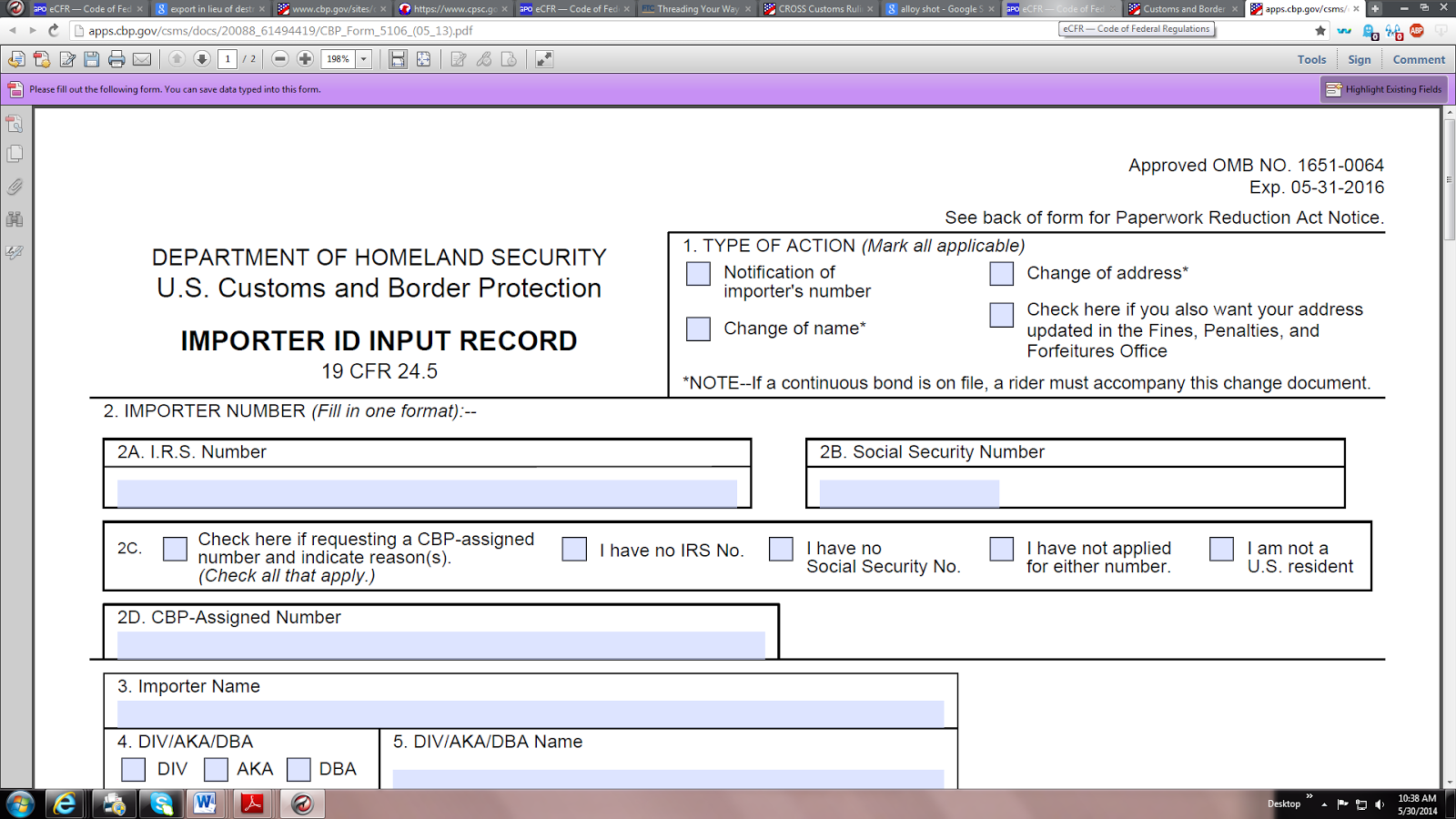


Links to these can be found here:

CUSTOMS BOND FORM (CF 301)

IMPORTER ID INPUT RECORD (CF 5106)

Any questions regarding either of these can be directed to Tom Scott, Office of Administration, at (317) 614-4502.

Any other questions or comments can be posted below or emailed to me at clark.deanna@gmail.com.


Keep up with me at www.fashioncompliance.com or:
On Twitter @fashcompliance

Monday, November 18, 2013

Does Your New Pair of Shoes Have a Fuzzy Bottom? CBP’s New ISO 20871 Determination


Strange but true, in certain cases where a textile material covers the “outermost sole” of a rubber or plastic soled shoe, the duty rate on such imported shoe may be lower than if the sole were without the “fuzz.”


This results because such textile coating can move an importation of footwear from one category, i.e., classification, to another, and with such move can come an accompanying change in the rate of duty (and possibly one that is favorable to the importer – think cheaper).
For anyone not well-versed in tariff-ease, all this really means is that a fuzzy bottom can cost less to import in to the US than one that is bare.
In case it is not obvious, the “outer sole” is that part of footwear (other than an attached heel) which, when in use, is in contact with the ground, i.e., the bottom of the shoe.

Since a more favorable duty rate may, at times, be obtained where footwear has an outer sole of textile, it’s not uncommon to find importers buying footwear that has a thin textile coating on the bottom (which can feel fuzzy) and then classifying the footwear under the tariff number for shoes having textile on its sole in order to take advantage of these duty savings.

Since US Customs is in the business of collecting as much money in duties (revenue) as possible, in an effort to curb inappropriate usage of such classifications, it routinely requests more information on imported shipments to confirm that the textile is actually there.

Starting this month (Nov. 2013), US Customs has decided that the ISO 20871 test method will be recognized in assessing the characteristics of the textile material attached to outer soles.

This means that when an importer is asked to provide more information (Customs Form 28) about a textile covered sole, an analysis performed by an independent lab using this test method (ISO 20871) should be presented.
 Also, keep in mind that US Customs can always conduct its own testing when circumstances warrant it.
To learn more about the impact of this, the newly branded US Fashion Industry Association (formerly USITA) is having a webinar on this.  More information on the event can be found here.

Questions/comments?  Post below or email me at clark.deanna@gmail.com  

Keep up with me!

On Facebook: www.facebook.com/fashioncompliance (*Like* the page to get updates)

On YouTube:  www.youtube.com/FashionCompliance
On Twitter:  @fashcompliance