Tuesday, August 13, 2013

Corporate Officer of Men’s Suit Importer Avoids Joint Payment of $2,392,307 in U.S. Customs Penalties

On July 30, 2013, in Slip. Op. 11-527, U.S. v. Trek Leather, Inc. and Harish Shadadpuri, the Court of Appeals for the Federal Circuit (CAFC) reversed a U.S. Court of International Trade decision to impose penalties on the corporate officer of an “Importer of Record.”


“Trek Leather” (Trek), whose President and sole shareholder is Mr. Shadadpuri, was the Importer of Record for seventy-two (72) entries of men’s suits.  Mr. Shadadpuri is also a 40% shareholder to “Mercantile Electronics,” which was the consignee of these shipments.

Both Trek and Mercantile Electronics provided “assists” (in the form of fabric) to their suit manufacturers and failed to declare their value to US Customs.  Mr. Shadadpuri even admitted that he knew Trek (the Importer of Record) should have included the value of fabric assists in its duties but did not bother to do so.

 US Customs therefore brought a lawsuit claiming that under 19 USC §1592, both Trek and Mr. Shadadpuri, in his personal capacity, were liable for a penalty of $2,393,307 for fraudulently, knowingly, and intentionally understating the dutiable value of the imported men’s suits. 

Since Trek, a corporation, was the Importer of Record, Mr. Shadadpuri argued he could only be personally liable if the government established that he had pierced Trek’s “corporate veil” or established that he had either committed fraud, or aided and abetted Trek’s fraud, making him liable under 19 USC §1592.

 As Trek had conceded during the course of the litigation however, that its activity rose to a level of gross negligence, the government abandoned its fraud claim against Trek and instead proceeded alternatively on a claim of gross negligence.
 
Mr. Shadadpuri in his defense, argued that corporate officers of an Importer of Record are not directly liable for penalties under 19 USC §1592 – and the court agreed. 

 The CAFC’s 1999 decision in United States v. Hitachi America, Ltd., 172 F.3d 1319 (Fed. Cir. 1999), held that because one cannot “aid and abet” negligent conduct, Mr. Shadadpuri could not be liable for Trek’s admitted negligence unless the government could prove he was acting as Trek’s alter ego rather than as an officer of the corporation acting in his capacity as such.
 
The CAFC, agreeing with Mr. Shadadpuri, stated that under the basic principles of corporate law, Mr. Shadadpuri could not be personally charged with a claim of negligence for the actions he took on behalf of the corporation.

In CAFC’s own words:
 
“[T]he government [US Customs] has asked us to adopt a broad legal principle that would expose all corporate officers and shareholders to personal liability for negligent acts they undertake on behalf of their corporation.  Absent an explicit statutory basis for doing so, we decline to believe Congress intended to supplant the common law so completely…”

 To read the full decision, click here.
 
Questions/comments?  Post below or email me at clark.deanna@gmail.com
 
 
Keep up with me:
On Twitter @fashcompliance  https://twitter.com/fashcompliance
 

Monday, August 5, 2013

AFL-CIO Sought Removal of GSP Benefits on Bangladesh Five (5) Years Ago Due to Worker’s Rights Deficiencies

Five (5) years and several high-profiled tragedies later, GSP treatment of all goods of Bangladesh origin will be suspended, effective September 3, 2013.


GSP stands for the Generalized System of Preferences which allows for the duty-free entry of roughly 3,500 GSP eligible products.

The AFL-CIO exists to represent people who work.  Read their mission statement below.

In 2007, the GSP Subcommittee accepted for review a GSP country practice petition submitted by the AFL-CIO seeking the removal of GSP benefits for Bangladesh based on the country's non-compliance with the GSP statutory eligibility criteria related to worker rights.

The GSP Subcommittee held public hearings on the petition in October 2007, April 2009, and January 2012, and also invited public comments on the petition on several occasions.

In 2011, U.S. imports from Bangladesh under GSP totaled $26.3 million. A full list of U.S. imports from Bangladesh under GSP may be found in the www.regulations.gov in docket number  USTR-2012-0036-0001.

While the leading GSP imports from Bangladesh included tobacco products, sports equipment, china kitchenware, and plastic articles, by being a GSP beneficiary country, it also had duty-free treatment on a number of textile accessories and some women’s or girls wearing apparel.

After reviewing the most recently available information, including updated reports from the AFL-CIO, the GSP Subcommittee believed that the lack of progress by the government of Bangladesh in addressing worker rights issues in the country warranted consideration of possible withdrawal, suspension, or limitation of Bangladesh's trade benefits under GSP. 

By statute, i.e., law, however, such change in Bangladesh's trade benefits under GSP required the President to make a determination, which he finally did.

On June 27, 2013, by Proclamation, President Obama revoked Bangladesh’s privilege of receiving treatment as a beneficiary developing country GSP.

As stated in his Proclamation, the reason for the revocation was because Bangladesh “has not taken or is not taking steps to afford internationally recognized worker rights to workers in [its] country."

The original petition and other information related to the review of Bangladesh are available for public viewing on www.regulations.gov in docket USTR-2012-0036.

For more information on GSP and GSP Eligible Products, click here.

AFL-CIO MISSION STATEMENT (as per its website)

The American Federation of Labor and Congress of Industrial Organizations is an expression of the hopes and aspirations of the working people of America.

We resolve to fulfill the yearning of the human spirit for liberty, justice and community; to advance individual and associational freedom; to vanquish ­oppression, privation and cruelty in all their forms; and to join with all persons, of whatever nationality or faith, who cherish the cause of democracy and the call of solidarity, to grace the planet with these achievements.

We dedicate ourselves to improving the lives of working families, bringing fairness and dignity to the workplace and securing social equity in the Nation.

Questions/comments?  Post below or email me at clark.deanna@gmail.com

Keep up with me:

On Twitter @fashcompliance  https://twitter.com/fashcompliance

Friday, July 26, 2013

Retailers and Importers May be Subject to More CPSC Certificate Requirements?


Ever Heard of a “Finished Product Certificate?”   Or a “Component Part Certificate?”
 

These are but two (2) of a list of new definitions that the Consumer Product Safety Commission (CPSC) is proposing to implement, and with newly defined terms of course, come new requirements.

Certification by a private labeler for products manufactured in the US is one of the proposed new rules, as well as the requirement by an importer of regulated finished products manufactured outside of the US to file its mandatory certificate at the time of filing the entry (and entry summary, if filed together).
Last Weekend To Get Your Comments in to CPSC on Certificates of Compliance

It is your last weekend to prepare and submit your comments related to these proposed rules as written comments must be received by  Monday, July 29, 2013.

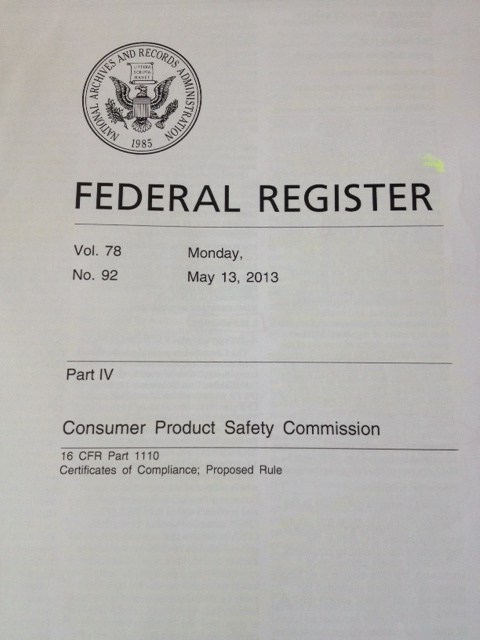
To read more about this and for the links on where to electronically submit your comments, check out the Federal Register notice announcing this proposed rule which may be found at 78 FR 28080 or by clicking here.

Questions/comments?  Post below or email me at clark.deanna@gmail.com
Join me:
On Facebook at https://www.facebook.com/FashionCompliance

On YouTube at http://www.youtube.com/user/fashioncompliance

On Tumblr: http://fashioncompliance.tumblr.com/

On Twitter @fashcompliance https://twitter.com/fashcompliance


Wednesday, July 17, 2013

Great Style at NYC Sustainable and Ethical Fashion Show

Models for 8 designers from New York City's Fair Trade Coalition strutted their stuff last week at a fashion show held at NYC's Fashion Institute of Technology.

The show was part of a 3 day sustainable fashion conference which had hands on workshops, like fabric dying using organic dyes, to breakout sessions, such as that on creating your digital media presence by sustainable fashion guru Kate Black, Founder of Magnifeco.


Expert panels rounded out the event, such as this one shown below, with Public Relations Specialist Jane Tabachnick, who moderated Jasmin Chua, Managing Editor of Ecouterre, Kristen Arnett, Founder and Editor-In-Chief of Green Beauty Team, and Fashion Compliance and International Trade attorney Deanna Clark, Esq. on the usage and evolution of "Green" and other environmental marketing claims.


All clothing and accessories worn by the models are made using fair trade principles and are made by designers who are part of the ethical fashion community in NYC.  

Designers include, Bhoomki, McColl & Clan, Simply Natural, Tabii Just, Elsa and Me, Tara Lynn Bridal, Reborn by Soham Dave, and Kibonen, who delivers both sustainable and ethical fashion from her production process in Cameroon to her shop in Harlem.  You can find her great designs at Kibonen's NYC store at 116th St. and Lenox Ave.

Questions/comments?  Post below or email me at fashioncompliance@gmail.com

Connect with me on Twitter @fashcompliance and join me at Fashion Compliance on Facebook!


Sunday, July 14, 2013

Luxury Africa – The Aesthetic Means More Than Just Great Fashion


Africa Fashion Week 2013 Celebrates Sustainable Luxury

Accessing these beautiful designs and increasing international trade with African countries is only a part of the reason why Africa Fashion Week 2013, starting this week from July 15 – 20th, 2013, is so important.


Purchasing products that impact families, establishes communities and raises awareness on social issues across the continent are just a few of the benefits that come from buying apparel Made in Africa.


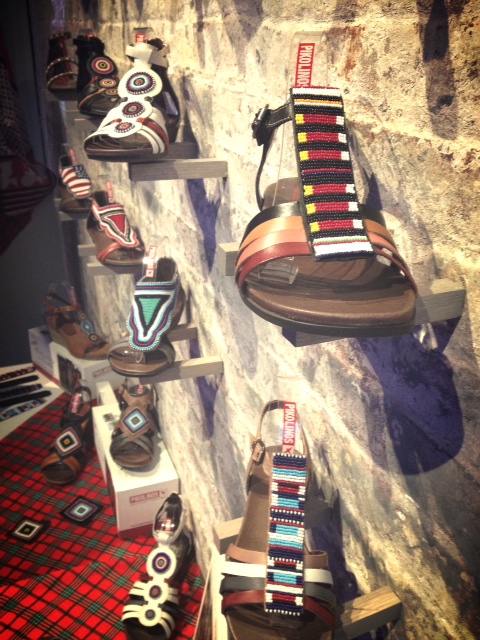
Spain-based footwear and apparel label “Pikolinos” turned to the Maasai people in Kenya to embellish its sandals with gorgeous beadwork. 

Recently, I attended an Africa Fashion Week pop-up shop at Pikolinos in NYC’s hip Meatpacking District. 
In addition to designers being in attendance, such as Missal Mussa (below right) from Zanzibar who is wearing a “Kikoe" type of skirt, there was also a sampling of the fashion to come from this year’s runway shows, such as this shirt above by designer Reuben Reuel De-Mestiks.


I enjoyed all the great design and of course, seeing my pals, including the Founder of Africa Fashion Week, Ms. Adiat Disu (shown with me in left photo above).

In a video entitled, “Our Take with Christina Brown & African Fashion Chic," Global Ambassador to Pikolinos, Ms. Bisila Bokoko, explains that the Maasai are a recognized tribe in today’s modern world and this collaboration has enabled Maasai parents to send their children to school, improve relations between husband and wife, and have access to better medical attention, among other reasons.

Mikaila Kim, fashion designer of “Aliakm” shown in the Arise News video, not only designs beautiful garments but she also incorporates images of child soldiers, brass knuckles and guns into her apparel in order to raise awareness about terrible events and realities that should not be forgotten.

Check out www.afwny.com for all the latest on African fashion and watch the Arise TV video to learn more.

Questions/comments?  Post below or email me at fashioncompliance@gmail.com

Keep up with me on Twitter @fashcompliance

Join us on Facebook on the Fashion Compliance page https://www.facebook.com/FashionCompliance

Friday, July 5, 2013

INDIA, DESIGN AND COTTON

India is known for its beautiful monuments and palaces, many of which were built over several hundreds of years ago.


It is likewise known for its designs and the patterns and shapes that have inspired countless artists, home fashions and furniture designers.

 India grows a lot of cotton and many of the t-shirts and other apparel manufactured there and in neighboring countries like Bangladesh originate from Indian cotton.


Here in the US we wear a lot of cotton garments manufactured in both of these countries, and if I had to guess, most of the time this little fact is overlooked.  

Have you ever stopped to ask yourself where the cotton you are wearing  comes from and how it got from the field to the factory?

Here are some images of a modern day mode of transportation in India where the farmer takes its raw goods from the field to the weigh stations to get paid for his crop.


One of the most fascinating aspects about international trade to me is the marriage of modern technologies contrasted with tried and true methods, all working in harmony together.  

One such example is that of the sophisticated container ship used for ocean transport of the finished goods that were once carried, in raw form, via camel power.  Pretty cool stuff.

Questions/comments?  Post below or email me at clark.deanna@gmail.com

Follow me on Twitter @fashcompliance

Keep up with me on Facebook by "liking" our Fashion Compliance page at https://www.facebook.com/FashionCompliance?ref=hl


Monday, July 1, 2013

Sustainable Fashion Beauty & Health Symposium @ FIT NYC

 Come Join Me for the Fashion Institute of Technology's
2nd Annual Sustainable Fashion Symposium! 

On July 11th, I'll be speaking on "Green Marketing Claims" during the afternoon panel starting at 3 PM.  Other highlights include a sustainable fashion tour in NYC, a sustainable fashion show, and networking events.  For tickets to the event, click here.


For current F.I.T. students with valid I.D., COMPLIMENTARY ADMISSION is available by typing in the promotional code "STUDENT" at checkout.  In order to gain access to the conference you will be required to show your F.I.T. student i.d. card, so don't forget it!
 
Questions/comments?  Post below or email me at fashioncompliance@gmail.com

Follow me on Twitter @fashcompliance or "like" us on the Fashion Compliance Facebook page
https://www.facebook.com/FashionCompliance